
Pay Bill Here - Fast and Convenient
BVIEC’S MONTHLY FUEL DATA – AUGUST & SEPTEMBER 2026
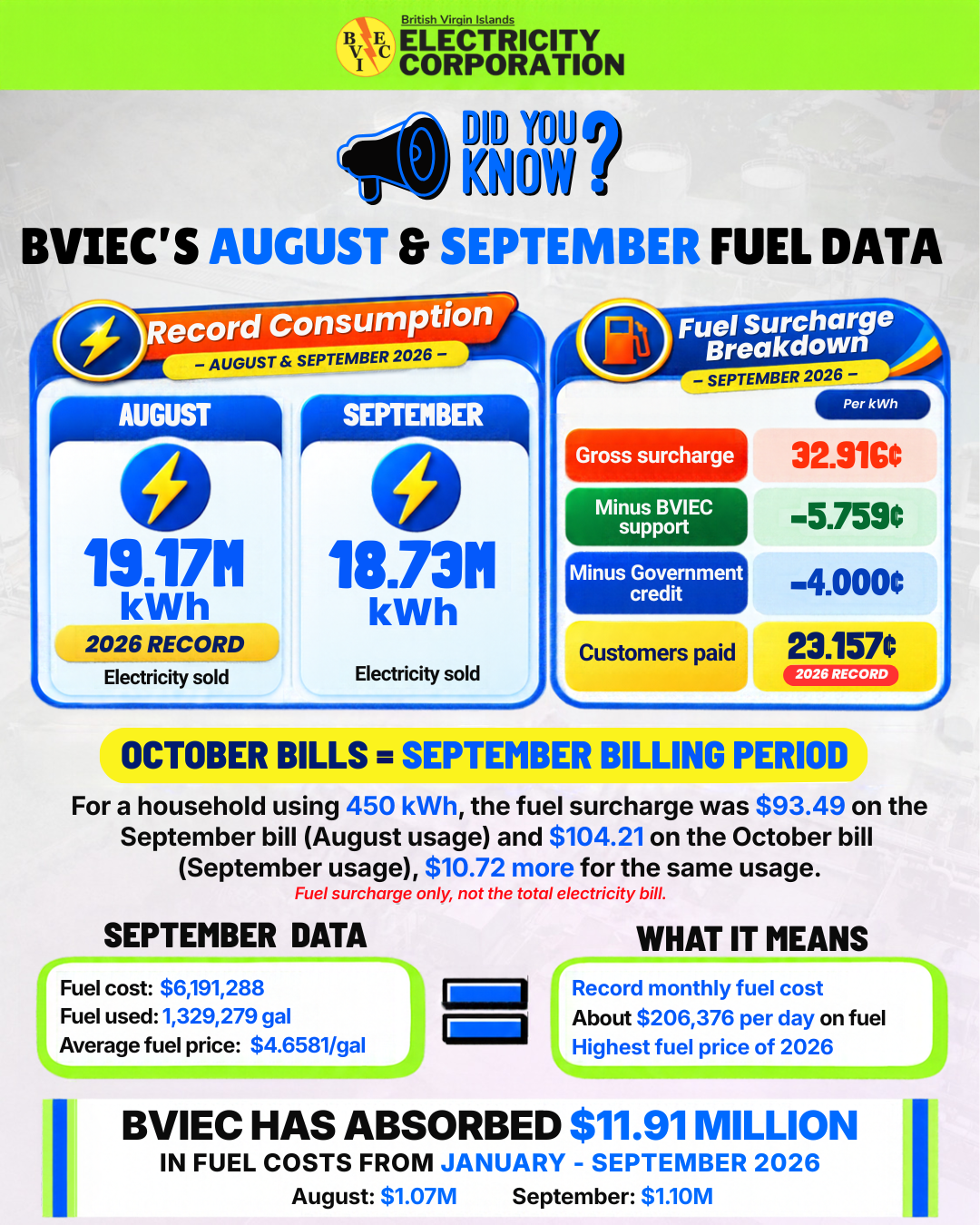
Tortola, British Virgin Islands, October 23, 2026 — This combined publication presents BVIEC’s fuel data for August and September 2026, two months that highlight the continued volatility of global fuel costs and their impact on powering the Virgin Islands.
August brought temporary relief. Despite record electricity sales of 19.17 million kWh, fuel consumption fell to 1.22 million gallons, reducing the value of fuel consumed to $5.24 million. The net fuel surcharge eased to $0.21775/kWh, further reduced to $0.20775/kWh through the Government’s $0.01/kWh credit.
September reversed those gains sharply. Fuel prices surged to a 2026 high of $4.6581 per gallon, pushing the value of fuel consumed to a historic $6.19 million. After BVIEC’s mandatory fuel subsidy, the net surcharge reached $0.27157/kWh. Despite the Government increasing its credit fourfold to $0.04/kWh, the effective customer rate climbed to $0.23157/kWh, the highest of 2026.
Importantly, the value of fuel consumed at BVIEC’s generation plants differs from the cost of fuel purchased from suppliers. The average price per gallon, used to calculate the fuel surcharge, is based on supplier invoices and the quantity purchased.
Through September, BVIEC has absorbed $11.9 million in fuel subsidies, continuing to cushion customers from rising costs while electricity tariffs remain unchanged since 1978.
The seven sections below explain what drove these costs, how subsidies and Government credits reduced customers’ bills, and what the figures mean for you.
AT A GLANCE — AUGUST & SEPTEMBER 2026 (7 Categories)
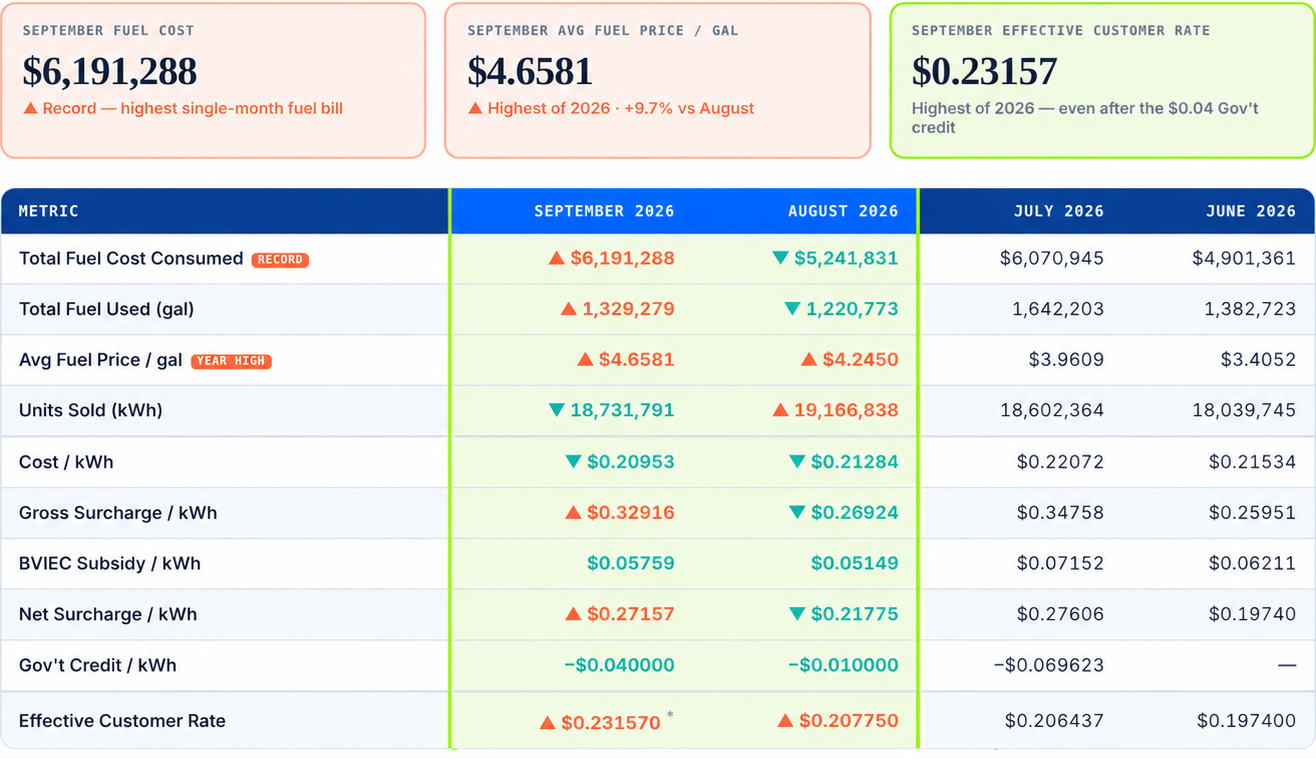
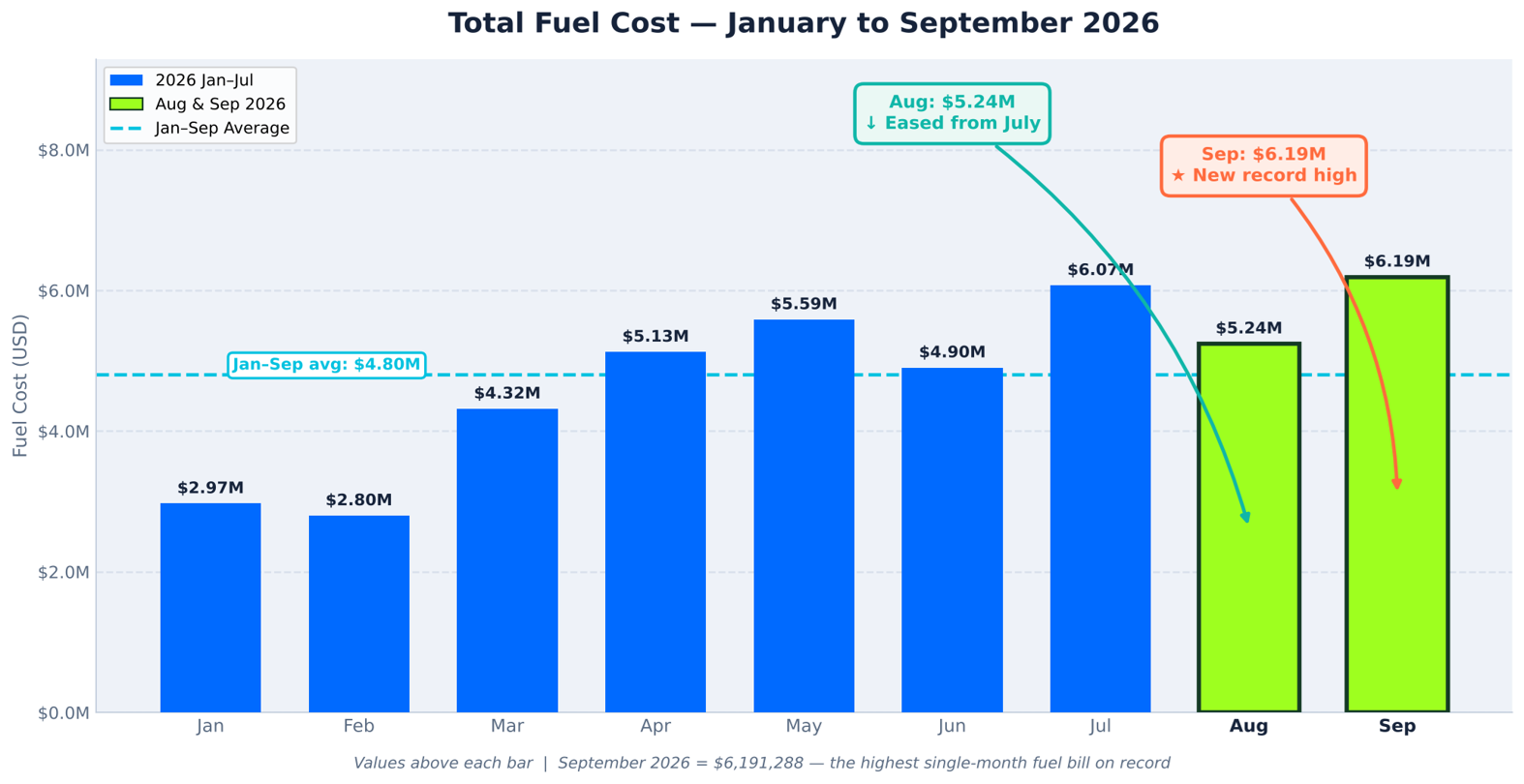
1) Total Fuel Cost Consumed: August $5,241,831 | September $6,191,288 (record high)
(July $6,070,945 | June $4,901,361)
What it Means:
This is the cost of the fuel actually consumed to generate power, and it is the figure that flows into the customer fuel surcharge. August eased to $5.24 million as less fuel was burned. September jumped to $6.19 million, the highest single-month fuel bill BVIEC has ever recorded, as both consumption and the world price climbed.
Why it Matters:
Fuel is the largest cost of producing power and the only part of the bill tied to the world market. When the fuel bill climbs, the surcharge climbs with it. September’s record fuel bill is why October bills are the highest of the year.
In September, the Corporation spent about $206,000 a day on fuel alone, roughly the price of a new luxury car every day of the month.
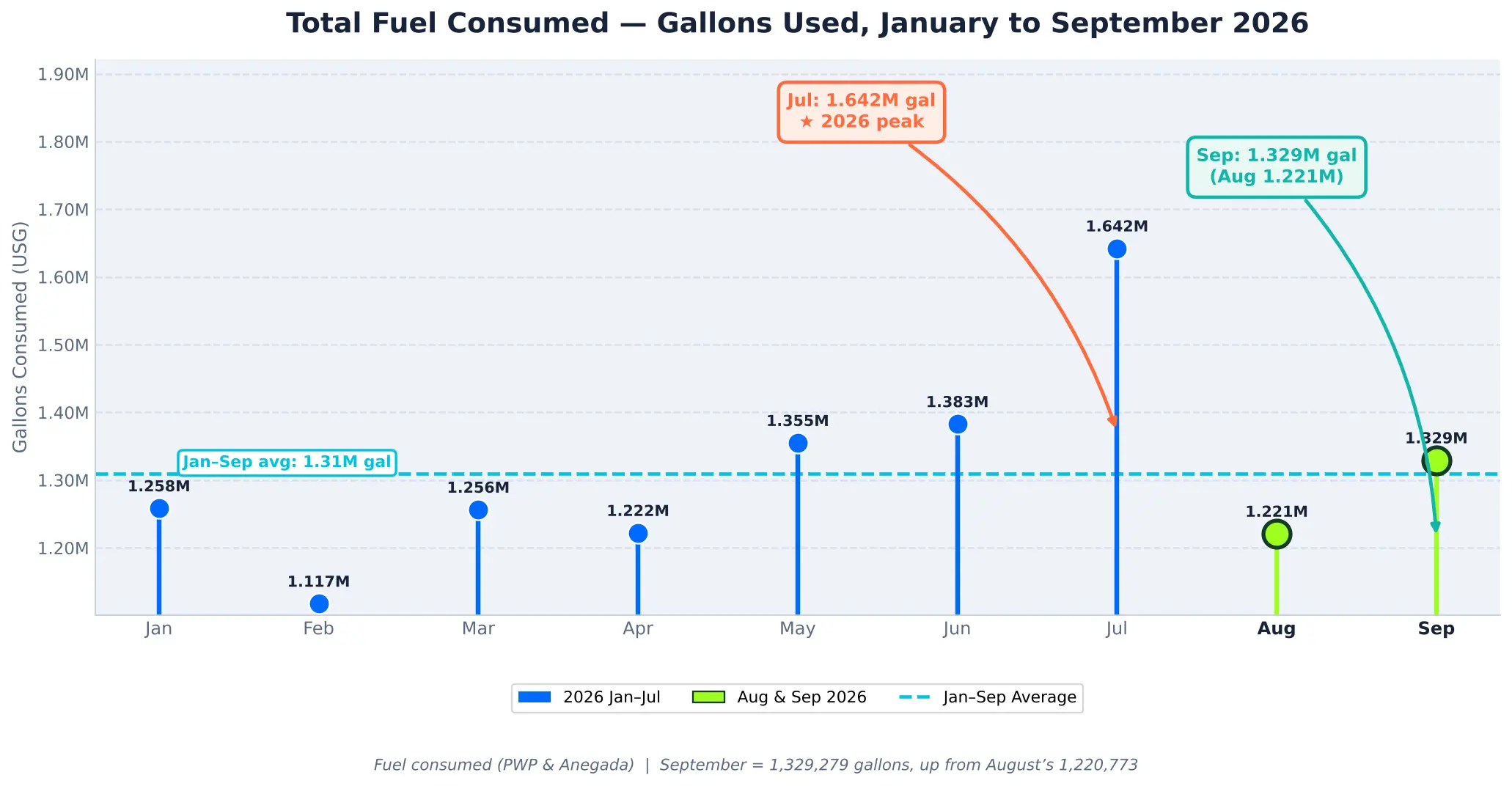
2) Total Fuel Used: August 1,220,773 gal | September 1,329,279 gal
(July: 1,642,203 gal | June: 1,354,923 gal)
What it Means:
This is the volume of diesel consumed to generate power (PWP & Anegada). August fell to 1.22 million gallons; September rose to 1.33 million as demand stayed high through the end of the summer.
Why it Matters:
More gallons burned means more cost, even before any price move. September’s higher volume, layered on a higher price per gallon, is what pushed the fuel bill to its record.
1.33 million gallons is about 53 tanker-truck loads in a single month, close to two a day.
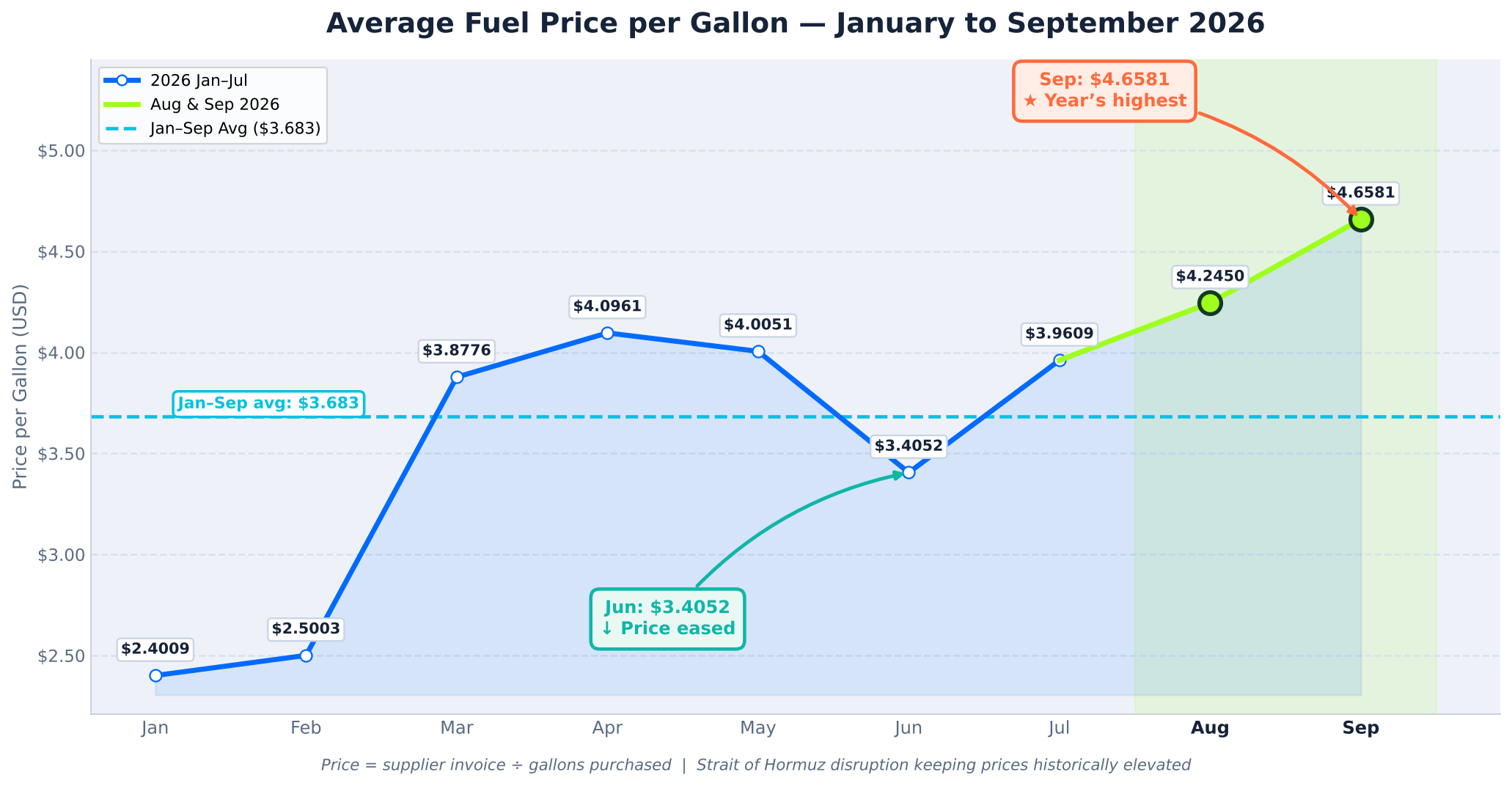
3) Average Fuel Price Per Gal: August $4.2450 | September $4.6581 (year’s highest)
(June $3.4052 | July $3.9609)
What it Means:
This is the price BVIEC paid per gallon, calculated as the supplier invoice divided by the gallons purchased. August was the highest of the year at the time, $4.2450. September set a new high at $4.6581 per gallon.
Why it Matters:
BVIEC does not set this price. It is inherited from global markets still pressured by the Strait of Hormuz disruption since March. The climb to $4.66 is the main driver of September’s record fuel bill and surcharge.
BVIEC purchases approximately 1.33 million gallons of fuel monthly. At that volume, every 1-cent increase adds roughly $13,300 in costs. September’s 41-cent price jump represented approximately $549,000 in additional fuel costs at the same volume, without generating a single extra unit of electricity.
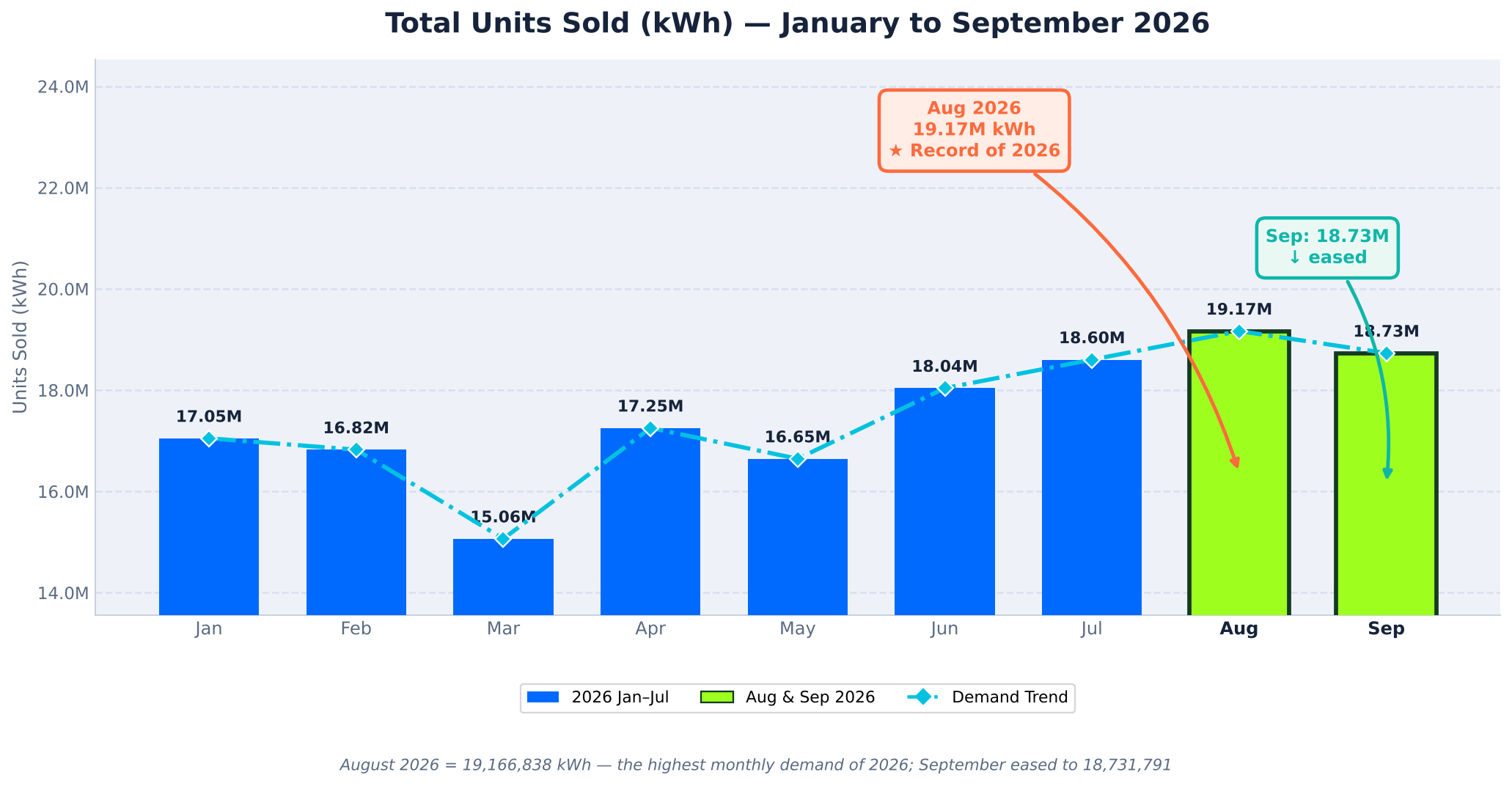
4) Total Units Sold: August 19,166,838 kWh | September 18,731,791 kWh
(July 18,602,364 kWh | June 18,039,745 kWh)
What it Means:
This is the electricity customers used and were billed for. August was the highest demand of any month in 2026 at 19.17 million kWh. September eased to 18.73 million, still among the strongest months of the year.
Why it Matters:
Higher usage lifts total bills before any price effect. August’s record demand and September’s record price are the two reasons these months stand out on customers’ bills.
September’s monthly total was lower than August’s, but it fell in a 30-day month rather than a 31-day one. Measured per day, the islands actually drew more power in September (about 624,000 kWh each day, against August’s 618,000 kWh) so demand did not truly ease; the calendar simply gave it one fewer day.
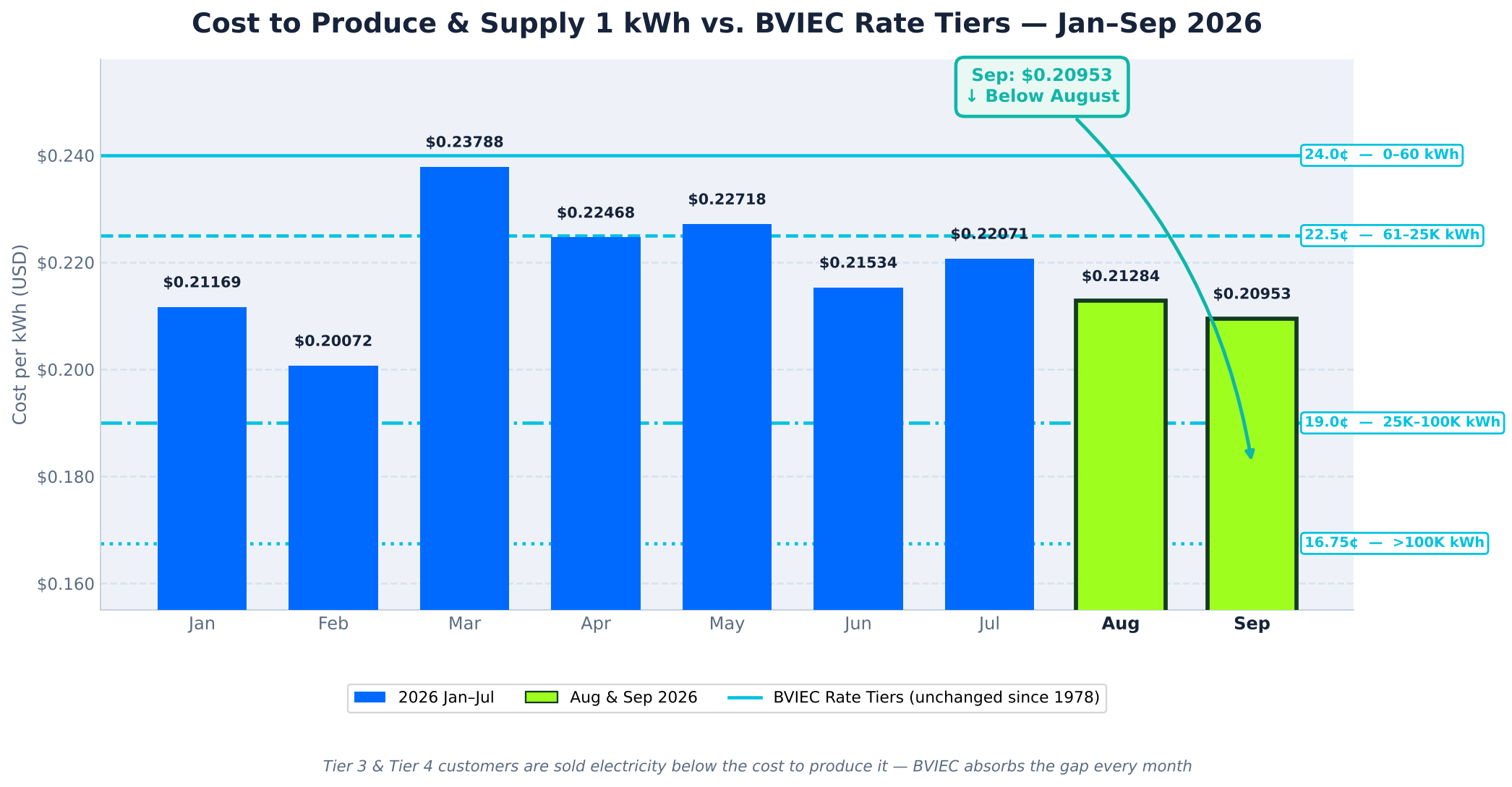
5) Cost to Produce & Supply 1 kWh: August $0.21284 | September $0.20953
(July $0.22071 | June $0.21534)
What it Means:
This is the all-in cost to generate and deliver one unit of electricity, covering fuel, generation, transmission and support. It held near 21 cents in both months, $0.21284 in August and $0.20953 in September.
Why it Matters:
Customer tariffs have not changed since 1978, from 24 cents on the first tier down to 16.75 cents, plus a $2.50 fixed charge. When it costs about 21 cents to make and deliver a unit, the gap between that cost and the fixed tariff is carried through the surcharge and by BVIEC, never a rate increase.
In September, BVIEC spent approximately $20.95 to produce and deliver 100 kWh, while its lowest tariff generated just $16.75 in base charges. This highlights the cost-recovery challenge of electricity rates.
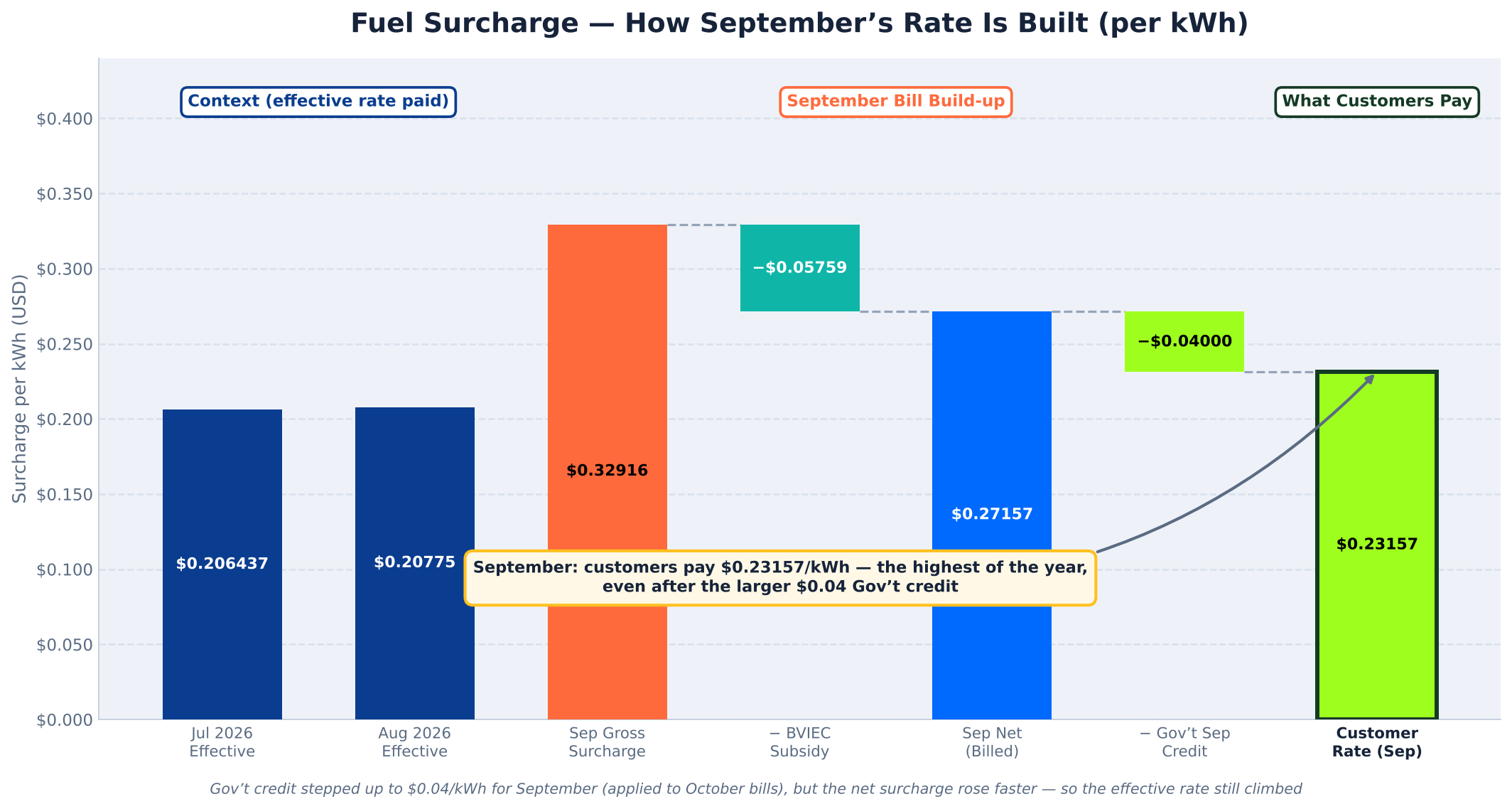
6) Fuel Surcharge: August $0.20775 | September $0.23157 (After BVIEC & Gov’t Subsidies)
(July $0.206437 | June $0.19740)
What it Means:
The surcharge is the part of the bill that moves with fuel. In August, the gross surcharge was $0.26924 per kWh, the net billed rate $0.21775, and after the Government’s $0.01 credit, customers paid $0.20775. In September, the gross rose to $0.32916 and the net billed rate to $0.27157; even after a larger $0.04 Government credit, customers paid $0.23157 per kWh, the highest customer rate of the year.
Why it Matters:
This is the number customers feel. August brought relief; September reversed it. The Government stepped its credit up from one cent to four cents, but the net surcharge rose faster, so the rate customers actually pay still climbed. August consumption was billed in September, and September consumption is billed in October.
On a home using 450 kWh, the surcharge paid was about $93.49 in August and about $104.21 in September, roughly $11 more for the same usage, driven entirely by fuel.
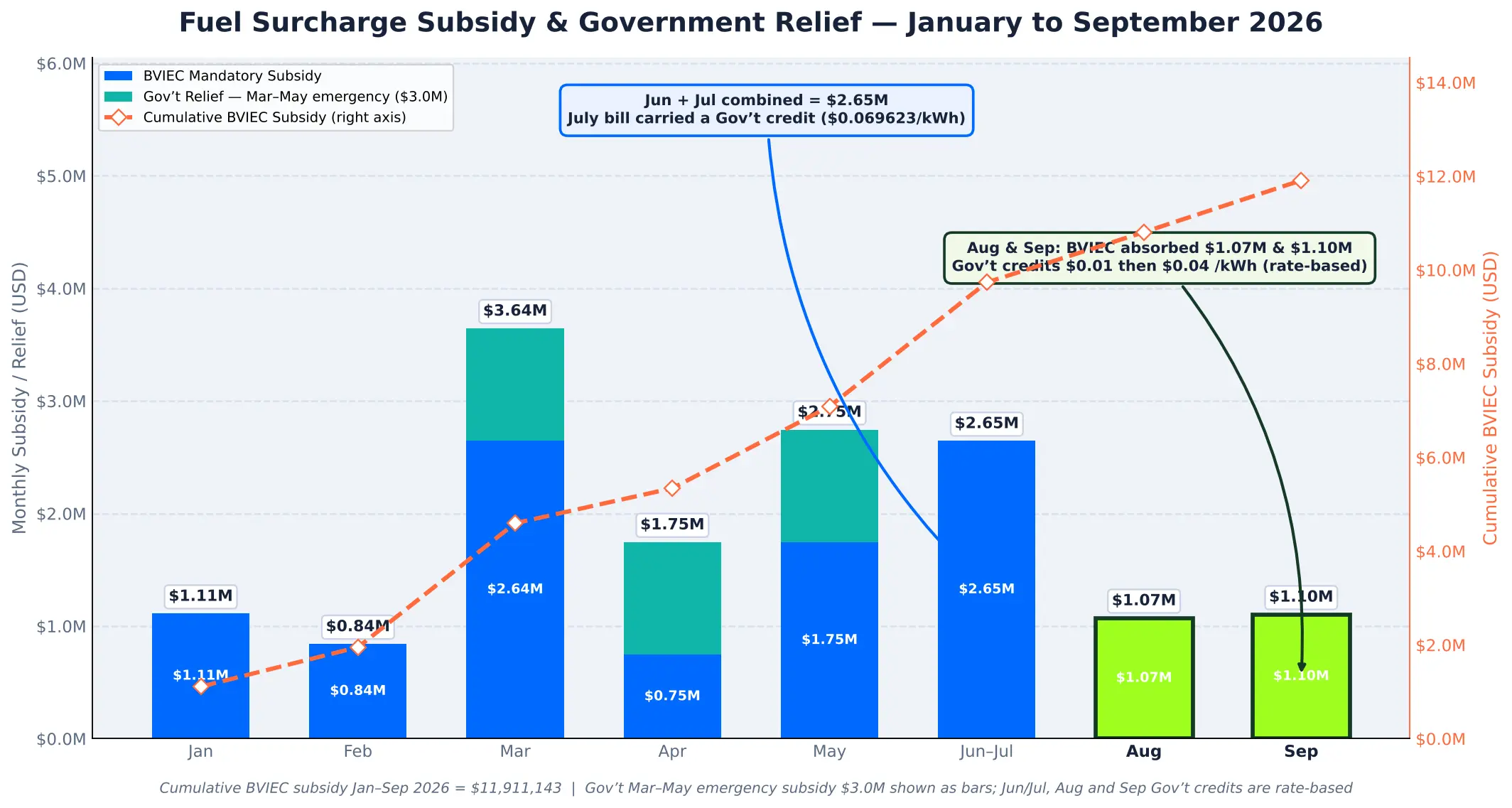
7) Fuel Surcharge Subsidy: August $1,072,147 | September $1,104,323 (Jan–Sep: $11.9M absorbed)
(June & July total = $2,645,354.18)
What it Means:
This is the money BVIEC absorbed so customers did not pay the full surcharge, about $1.07 million in August and $1.10 million in September.
Why it Matters:
This is the shield between world fuel prices and your bill, and it has not let up. Through September, BVIEC has absorbed $11.9 million in fuel costs this year, now alongside the Government’s rate-based credits of $0.01 per kWh in August and $0.04 in September.
The $11.9 million in fuel subsidies is equivalent in value to approximately 3,150 kWh of free electricity per customer, across approximately 18,000 accounts. That’s nearly three months of free electricity for customers using up to 1,100 kWh monthly!
Two months, two Government credits
The Government applied a credit of $0.01 per kWh for the August billing period (reflected on September bills) and $0.04 per kWh for September (reflected on October bills). Both sit on top of the amount BVIEC already absorbs. In August, the credit, plus a smaller fuel bill, held the rate customers pay to $0.20775. In September, the net surcharge rose so sharply that even the larger four-cent credit could not fully offset it, and the effective rate reached $0.23157 per kWh.
World fuel prices remain the driver. The disruption around the Strait of Hormuz since March 2026 has kept global diesel elevated, which is why September’s price per gallon set a new high. BVIEC continues to carry a large share of that cost, $11.9 million through September, so it does not all reach customers.