
UNDERSTANDING YOUR ELECTRICITY BILL: Fuel Costs, Subsidies & the July 2026 Impact

Tortola, British Virgin Islands, August 25, 2026 — The presentation below was delivered to the public by Dr. Neil Smith, General Manager of the BVI Electricity Corporation (BVIEC), during a joint press conference with the Minister for Communications and Works, Hon. Kye Rymer. The briefing was intended to provide greater clarity on the higher electricity bills received by customers in August 2026, which reflected electricity consumed during July, and to explain the factors that contributed to the increase, including exceptionally high fuel costs. The presentation also outlined how BVIEC calculates the fuel surcharge, the impact of BVIEC’s mandatory fuel subsidy, and the role of the Government Fuel Subsidy Assistance Programme in reducing costs to customers, while providing important context on the measures being taken to ease the financial impact on households and businesses.
1) What Is a Fuel Surcharge?
A fuel surcharge is a separate charge on an electricity bill that reflects changes in the cost of fuel used to generate electricity. Because fuel prices can rise or fall from month to month, the surcharge allows BVIEC to recover the portion of fuel costs that is above the fixed amount already absorbed by the Corporation. It is not an increase in BVIEC’s legislated electricity rates.
2) How Does It Affect Customers?
When fuel prices rise, the fuel surcharge increases and customers may see a higher electricity bill, even if their electricity usage remains the same. When fuel prices fall, the surcharge also decreases. The amount each customer pays depends on how much electricity they use during the month, so higher consumption results in a higher total fuel surcharge. BVIEC’s mandatory fuel subsidy, and any additional Government assistance, help reduce the amount ultimately passed on to customers.
3) How BVIEC Calculated the July 2026 Fuel Surcharge
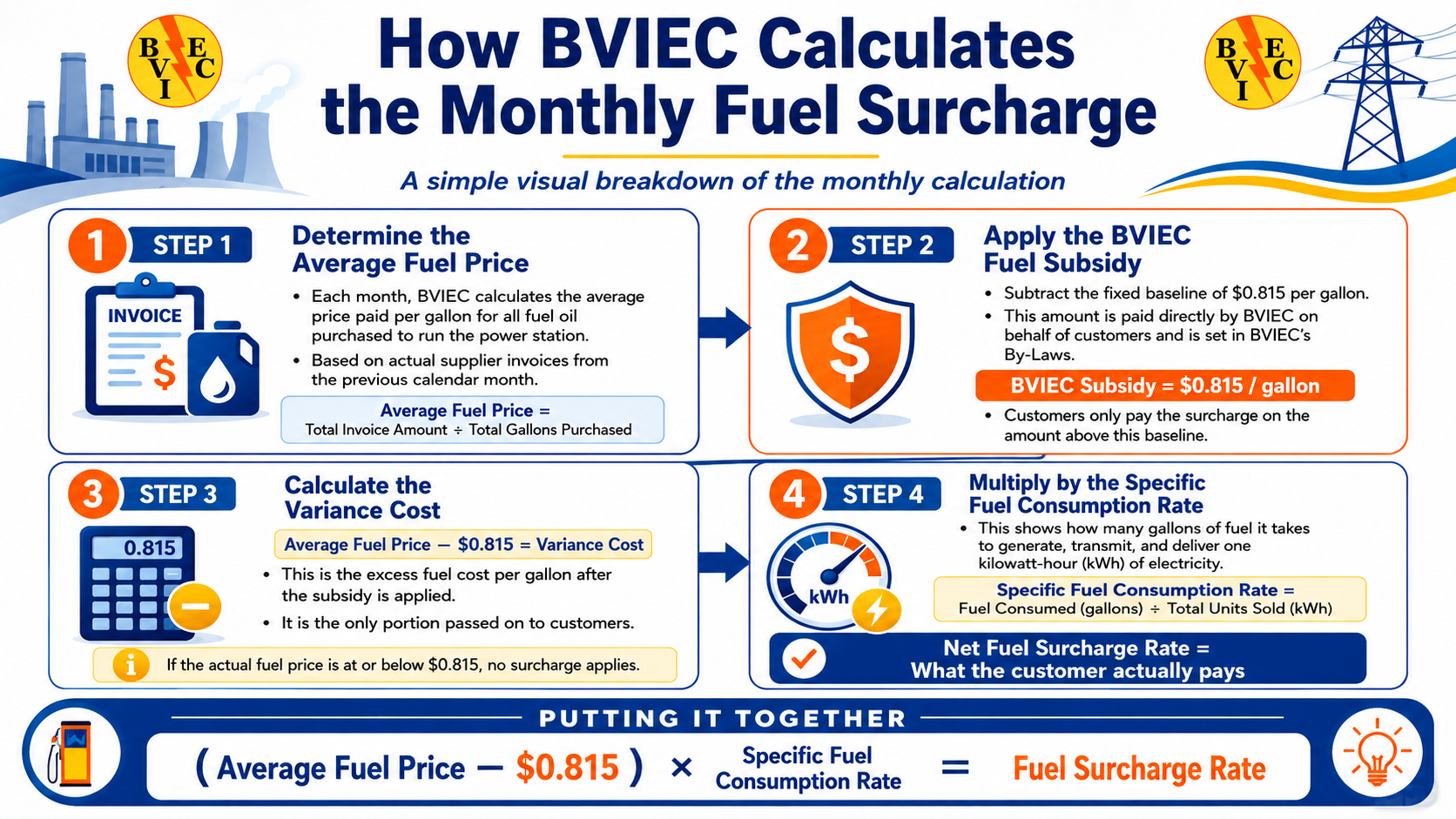

The flyer explains BVIEC’s fuel surcharge in four simple steps. First, BVIEC calculates the average price paid per gallon of fuel by dividing the total cost of fuel purchased by the total gallons purchased. Second, BVIEC subtracts its fixed $0.815 per gallon contribution, meaning customers are not charged the full fuel price. Third, BVIEC calculates the Specific Fuel Consumption Rate by dividing the total gallons of fuel consumed by the total kilowatt-hours (kWh) of electricity sold. Finally, the average fuel price is multiplied by the Specific Fuel Consumption Rate to determine the Gross Fuel Surcharge, after which BVIEC’s contribution is deducted to arrive at the Net Fuel Surcharge charged to customers.
Using July 2026 as the example: BVIEC purchased 1,316,392 gallons of fuel for $5,214,075.64, giving an average fuel price of $3.96088 per gallon. BVIEC also consumed 1,632,408.06 gallons while selling 18,602,364 kWh, producing a Specific Fuel Consumption Rate of 0.08775272 gallons per kWh. Multiplying $3.96088 × 0.08775272 gives a Gross Fuel Surcharge of $0.34758 per kWh, or 34.76¢. BVIEC’s $0.815 per gallon contribution is equivalent to $0.07152 per kWh, or 7.15¢, which is deducted from the gross amount. This leaves the Net Fuel Surcharge of $0.27606 per kWh, or 27.61¢ per kWh, charged to customers.
4) How Fuel Costs and Subsidies Shaped Customer Surcharges in 2026

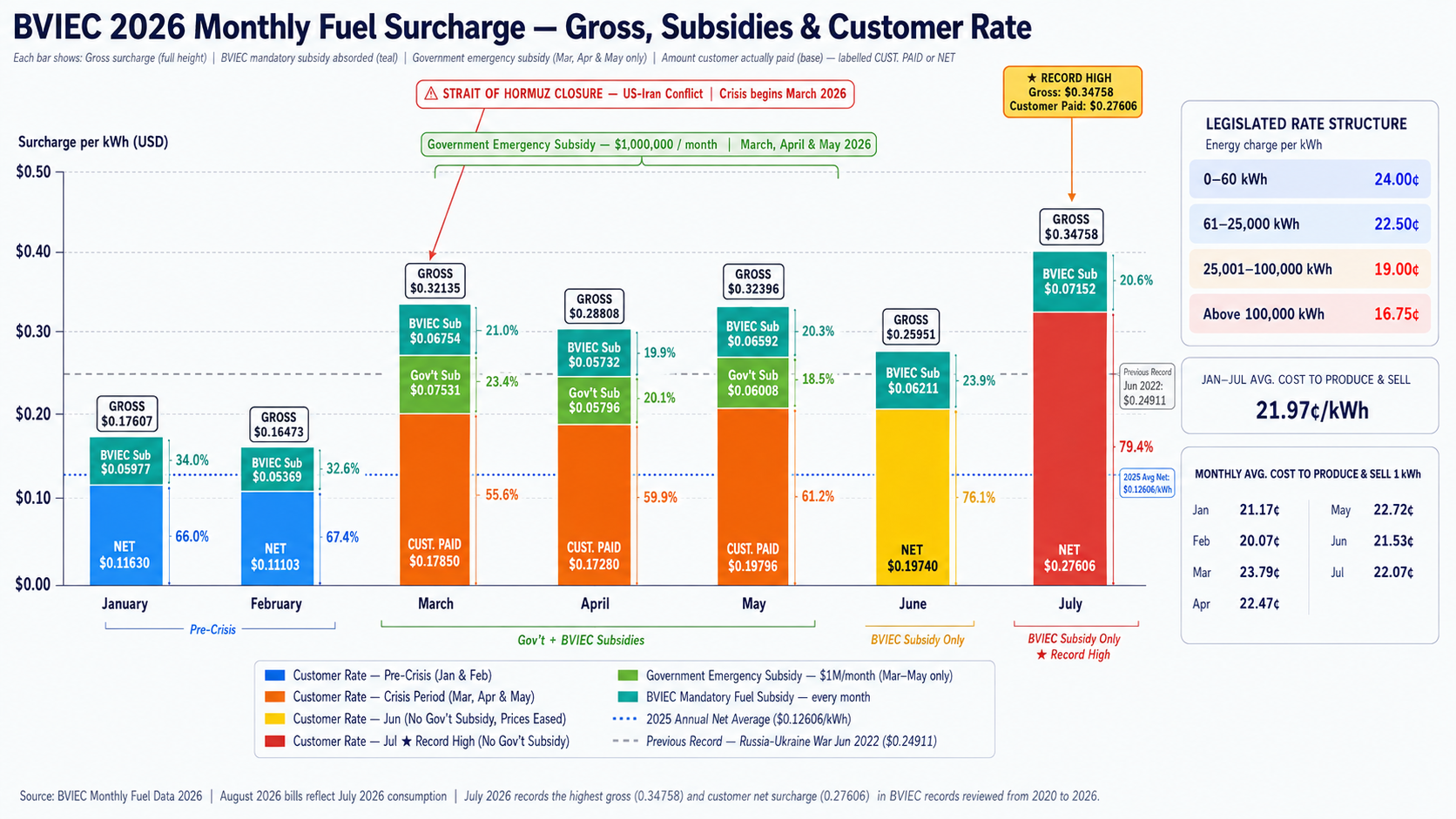
The graph shows how BVIEC’s monthly fuel surcharge changed from January to July 2026, and how subsidies reduced the amount ultimately paid by customers. In January and February, customer fuel surcharge rates were relatively lower at 11.63¢ and 11.10¢ per kWh. As international fuel prices increased from March onward, the Government provided an emergency subsidy of $1 million per month for March, April and May, while BVIEC continued applying its own mandatory fuel subsidy every month. These combined subsidies helped keep the customer-paid surcharge below the full or gross fuel surcharge during that period.
By June, the Government’s emergency subsidy had ended, leaving only BVIEC’s subsidy in place. In July, the gross fuel surcharge reached a record $0.34758/kWh (34.76¢). After BVIEC absorbed $0.07152/kWh (7.15¢), customers paid a net fuel surcharge of $0.27606/kWh (27.61¢). This was the highest customer fuel surcharge in the 2020–2026 records reviewed, exceeding the previous high recorded during the Russia–Ukraine conflict in June 2022. The graph therefore highlights both the sharp rise in fuel costs during 2026 and the significant role subsidies played in reducing what customers actually paid.
5) What It Cost BVIEC to Produce and Supply Electricity in 2026

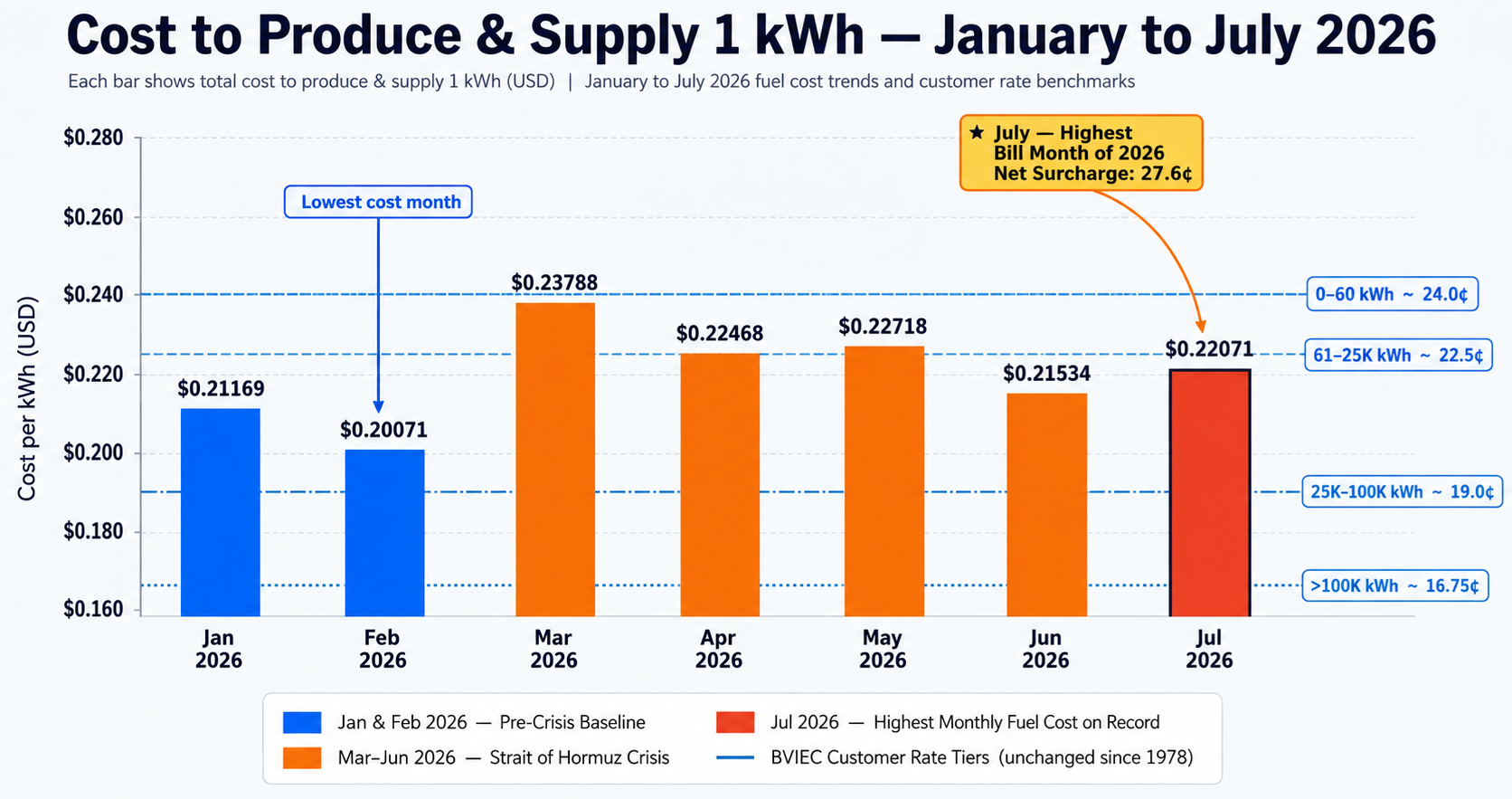
The graph shows BVIEC’s monthly cost to produce and supply one kilowatt-hour (kWh) of electricity from January to July 2026. Costs ranged from a low of 20.07¢/kWh in February to a high of 23.79¢/kWh in March, before settling at 22.07¢/kWh in July. The chart also compares these actual production costs with BVIEC’s legislated customer energy rates of 24.0¢, 22.5¢, 19.0¢ and 16.75¢ per kWh, depending on the customer’s consumption level. This illustrates that customers in the lower-priced rate tiers, particularly larger users paying 19¢ or 16.75¢ per kWh, are charged less for the energy component than it costs BVIEC to produce and supply each kWh, with BVIEC absorbing that difference.
6) How Subsidies Reduced a Typical 450 kWh Electricity Bill

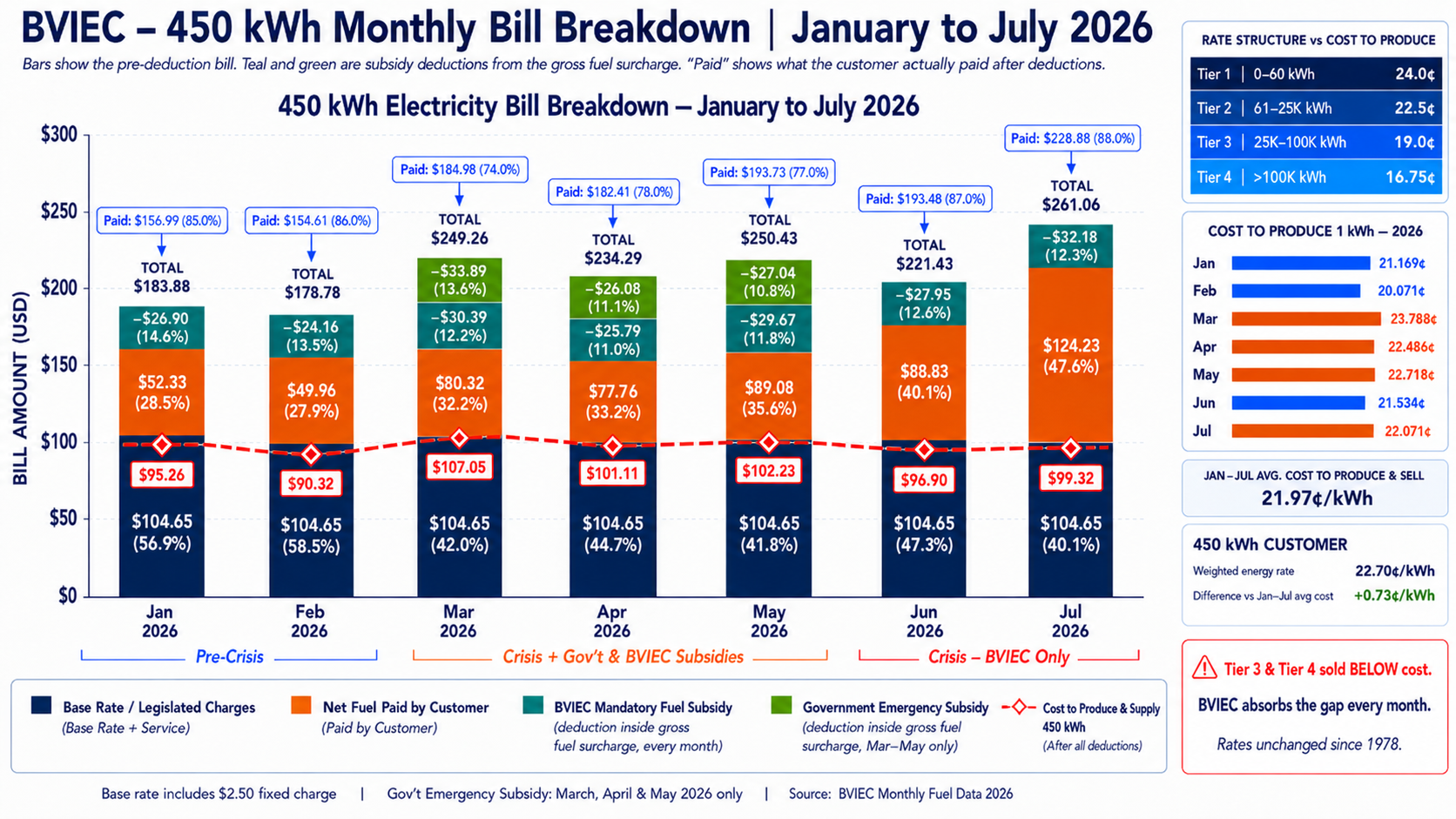
The graph shows how the monthly bill for a customer using 450 kWh changed from January to July 2026. The customer’s base electricity charge remained constant at $104.65 each month; what changed was the fuel surcharge as fuel prices moved. Each full bar represents the bill before fuel subsidies are deducted, while the figure marked “Paid” shows what the customer actually paid after assistance. BVIEC applied its mandatory fuel subsidy every month, and from March through May, the Government’s emergency fuel subsidy provided additional relief.
The impact is clearest in July. Without BVIEC’s subsidy, the 450 kWh bill would have been $261.06. BVIEC absorbed $32.18, reducing the customer’s actual bill to $228.88. Earlier in the year, the combined Government and BVIEC subsidies provided even greater protection, for example, in March the pre-subsidy bill was $249.26, but the customer paid $184.98 after $64.28 in combined subsidies. Overall, the graph demonstrates that the rise in customers’ bills during 2026 was driven primarily by higher fuel costs, not an increase in BVIEC’s legislated electricity rates.
7) How Fuel Costs Affected a 30,000 kWh Customer’s Bill

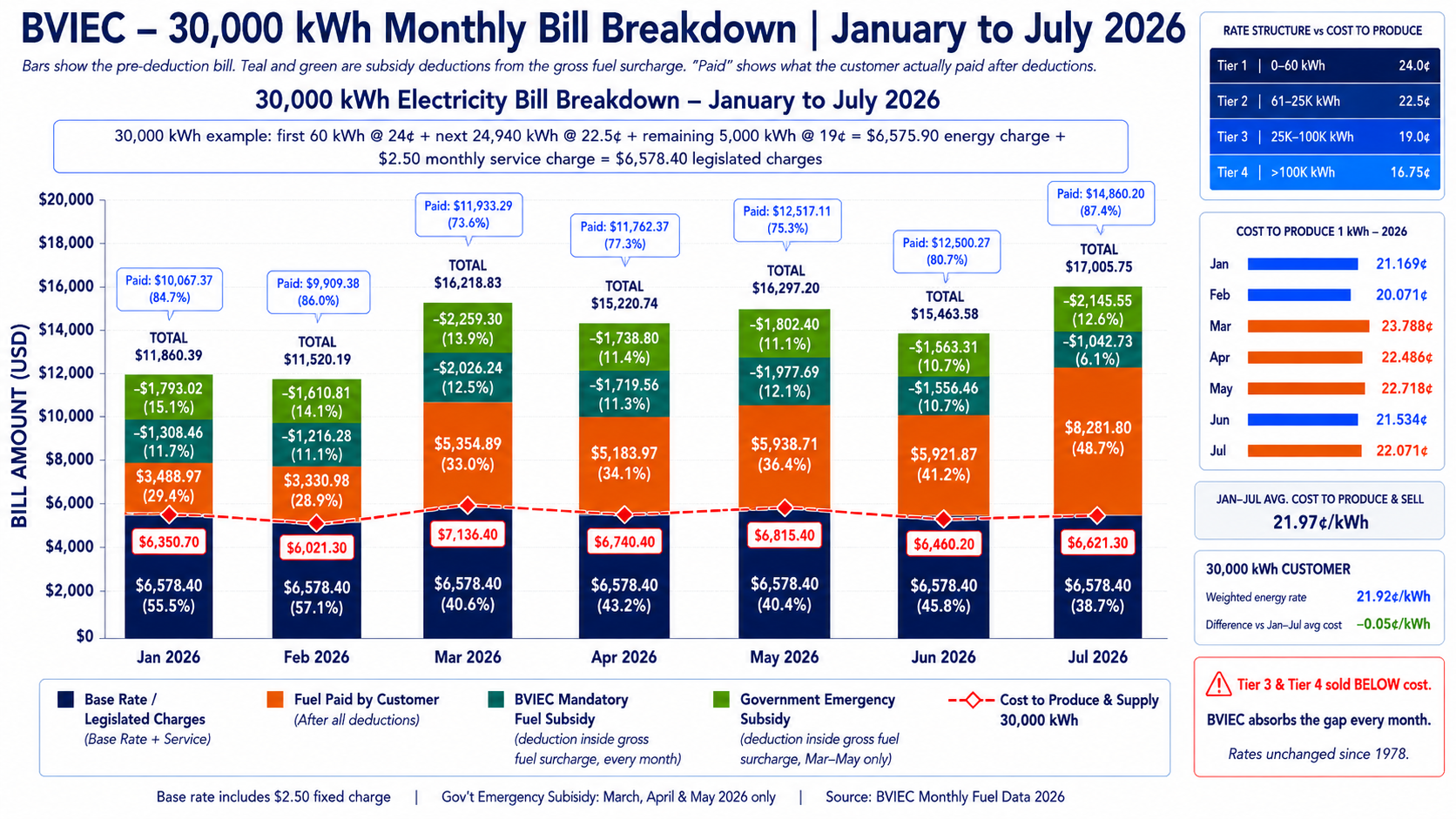
The graph shows how the monthly bill for a customer using 30,000 kWh changed from January to July 2026. The customer’s legislated electricity charges remained fixed at $6,578.40 each month, based on BVIEC’s existing rate tiers; the main change from month to month came from the fuel surcharge. BVIEC’s mandatory fuel subsidy reduced the gross fuel surcharge throughout the period, while the Government’s $1 million monthly emergency subsidy from March to May provided additional relief during the sharp rise in global fuel prices.
By July, higher fuel costs pushed the customer’s pre-subsidy bill to $17,005.75. After the applicable fuel subsidy was deducted, the customer actually paid $14,860.20, including $8,281.80 in fuel surcharge charges. The graph also shows that a 30,000 kWh customer pays a weighted energy rate of approximately 21.92¢/kWh, slightly below BVIEC’s January–July average cost of 21.97¢/kWh to produce and supply electricity. Overall, the chart demonstrates that the increase in the customer’s bill was driven primarily by higher fuel costs, not an increase in BVIEC’s legislated electricity rates.
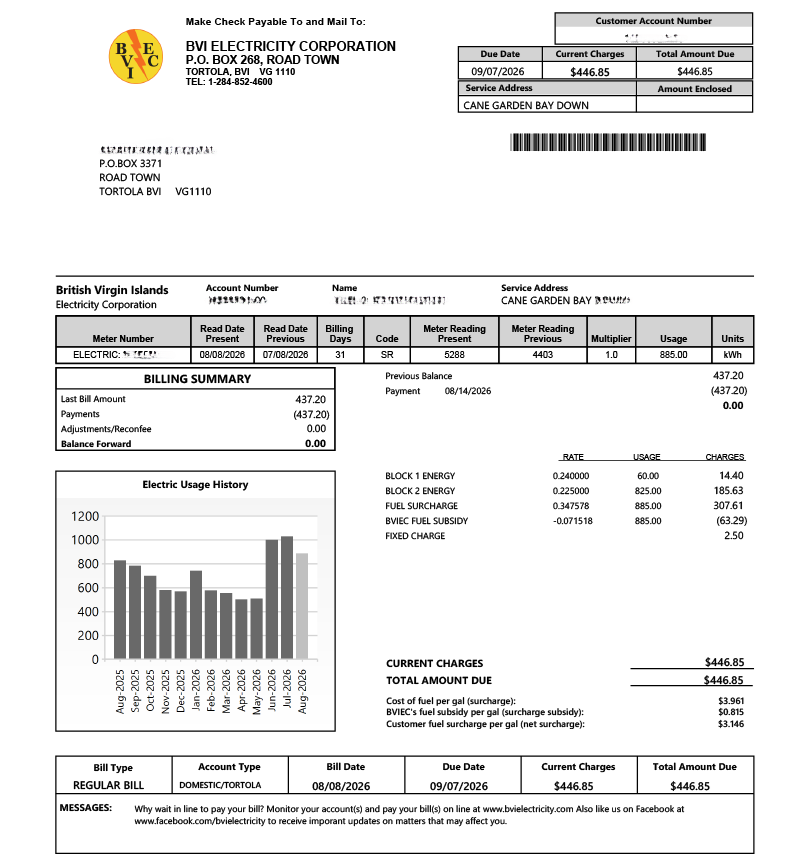
8) A Real August Bill: What Made Up the $446.85 Total

This actual bill, received in August 2026 for 885 kWh of electricity usage, shows clearly how the total charge of $446.85 was calculated. The customer’s regular electricity charges were $14.40 for the first 60 kWh and $185.63 for the remaining 825 kWh, plus the $2.50 fixed charge. Together, these standard electricity charges total $202.53. Importantly, these legislated electricity rates did not change.
The remaining $244.32 of the bill came from the net fuel surcharge. July’s gross fuel surcharge was $0.347578/kWh (34.76¢), which would have added $307.61 to this bill. However, BVIEC applied its mandatory fuel subsidy of $0.071518/kWh (7.15¢), reducing the bill by $63.29. This left the customer paying a net fuel surcharge of $0.27606/kWh (27.61¢), or $244.32 for 885 kWh. In simple terms, more than half of this customer’s $446.85 bill was attributable to the fuel surcharge, driven by July’s exceptionally high fuel costs, rather than an increase in BVIEC’s electricity rates.
Archive
- August 2026
- July 2026
- June 2026
- May 2026
- April 2026
- March 2026
- February 2026
- January 2026
- December 2025
- November 2025
- October 2025
- September 2025
- August 2025
- July 2025
- June 2025
- May 2025
- April 2025
- March 2025
- January 2025
- December 2024
- July 2024
- February 2024
- June 2023
- December 2022
- August 2022
- January 2022
- November 2021
- October 2021
- May 2021
- January 2021
- December 2020
- June 2020
- March 2020
- October 2019
- August 2019
- November 2018
- July 2018
- August 2017
- May 2017
- January 2017
- October 2016
- September 2016
- August 2016
- March 2015
- December 2014