
Pay Bill Here - Fast and Convenient
BVIEC’S MONTHLY FUEL DATA – JUNE & JULY 2026
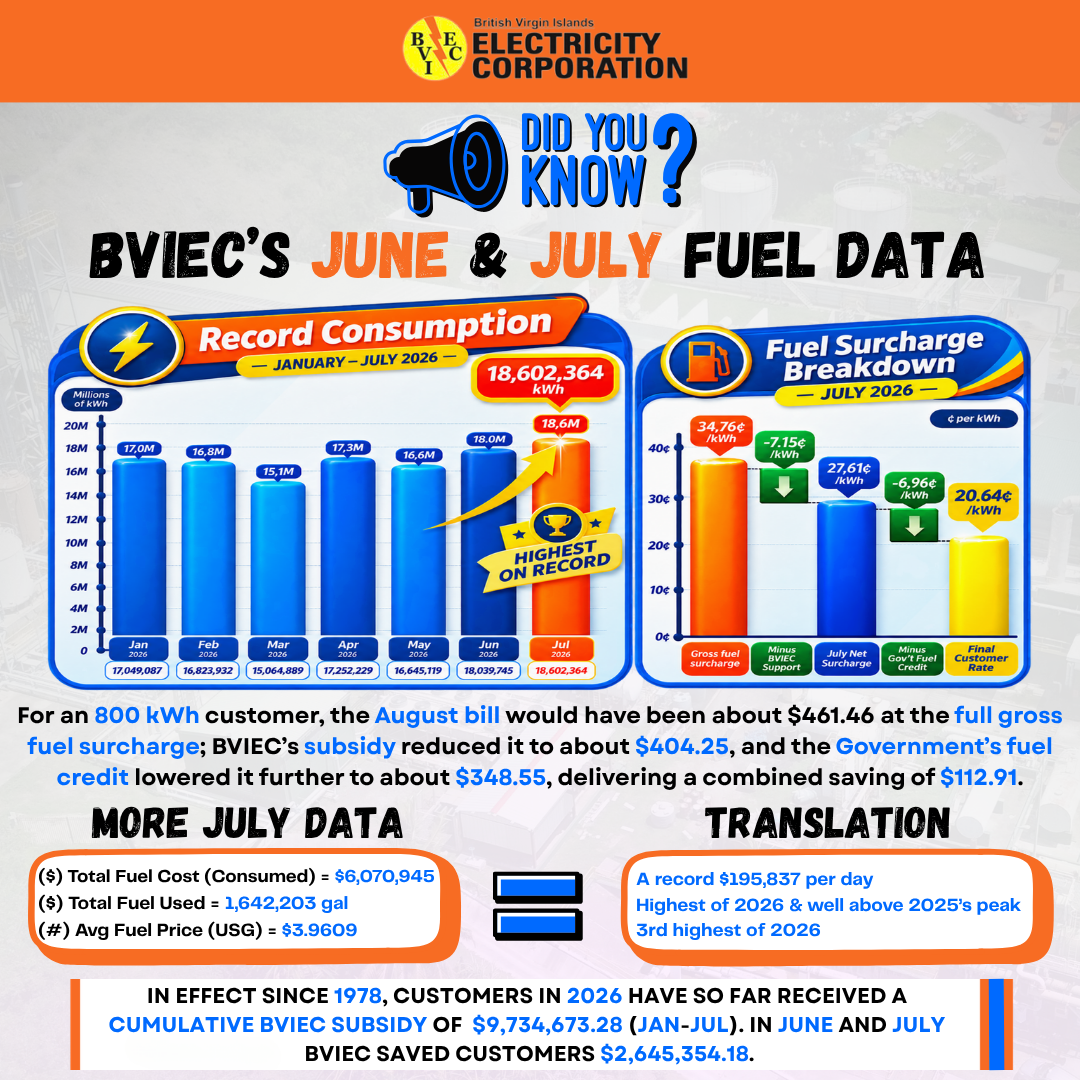
Tortola, British Virgin Islands, August 31, 2026 — This combined publication covers BVIEC’s fuel data for June and July 2026, two months that show just how quickly global fuel conditions can change what it costs to power the Territory.
June brought temporary relief. Fuel prices fell from $4.005 to $3.405 per gallon, helping reduce total fuel costs and lowering the net fuel surcharge to $0.19740/kWh.
July reversed those gains sharply. Fuel prices climbed back to $3.9609 per gallon, while peak summer demand pushed fuel consumption at BVIEC’s generation plants to a 2026 high of 1.64 million gallons. The value of that fuel consumed during July totalled a record $6.07 million.
It is important, however, to distinguish this figure from the fuel purchased from BVIEC’s supplier during the month. In July, BVIEC was invoiced $5,214,075.64 for 1,316,392 gallons of fuel purchased. Dividing that supplier cost by the gallons purchased produces July’s average fuel price of $3.9609 per gallon, the figure used in calculating the fuel surcharge.
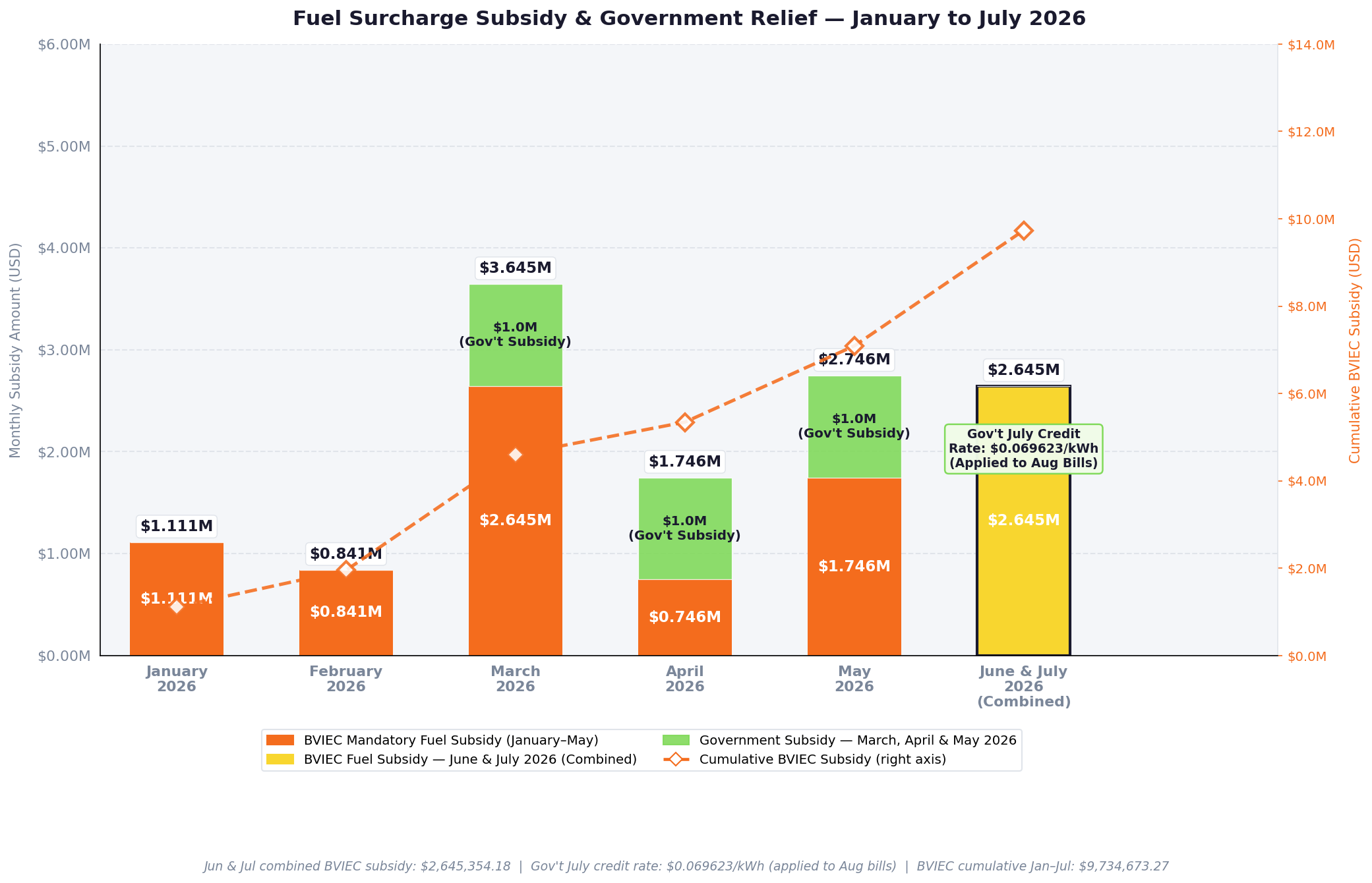
After BVIEC’s mandatory fuel subsidy, July’s net fuel surcharge was $0.27606/kWh. In response to the exceptional increase reflected in August bills, the Government also provided an additional credit to help cushion customers. Through July 2026, BVIEC has absorbed $9.73 million in fuel subsidies on behalf of customers.
These figures show the real difference between what global fuel markets cost BVIEC, what was required to generate electricity, and what customers were ultimately asked to pay.
The seven sections below explain, transparently and in practical terms, what drove the costs, how customers were protected, and what the numbers mean for you.
AT A GLANCE — JUNE & JULY 2026 (7 Categories)
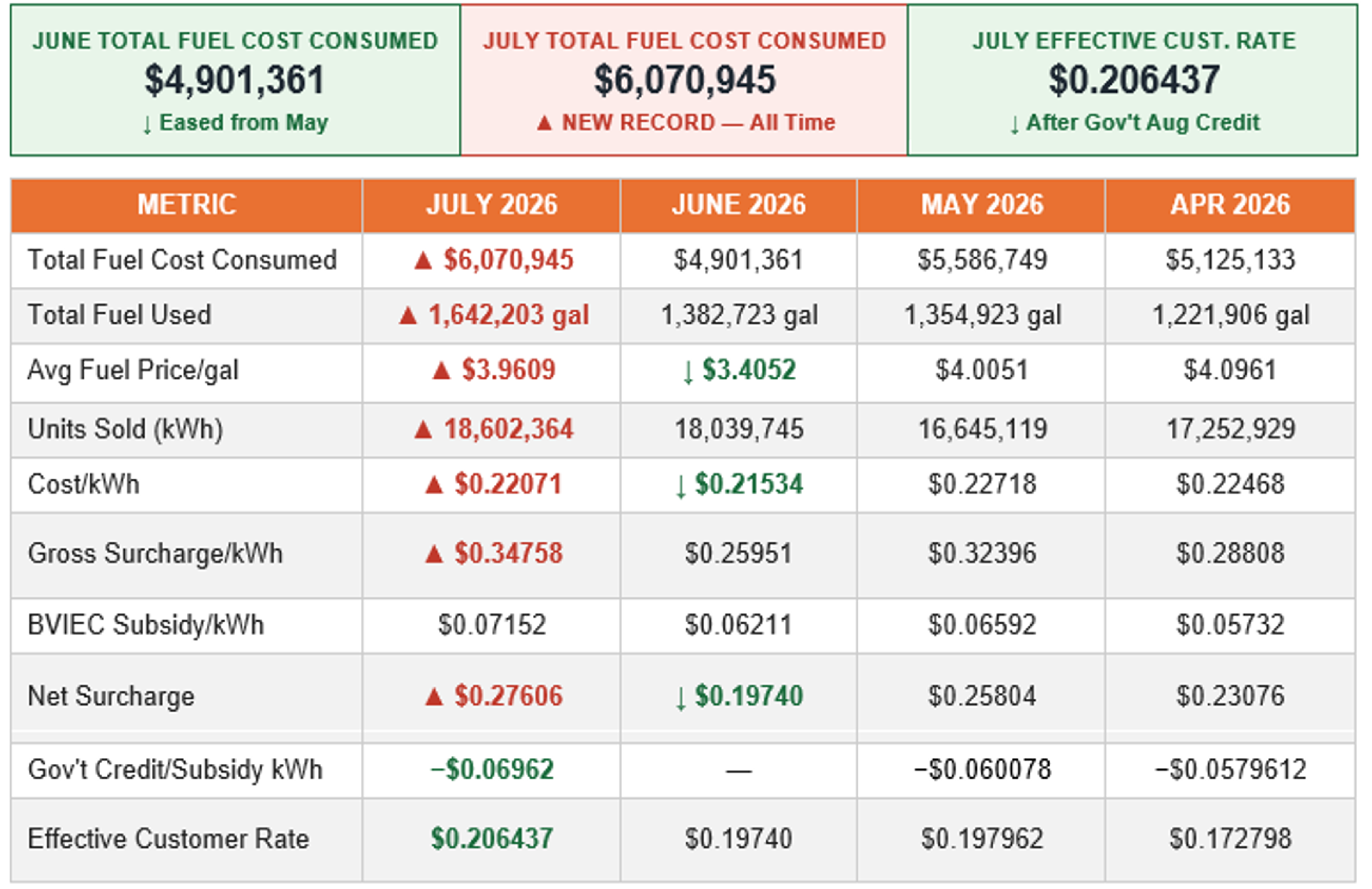
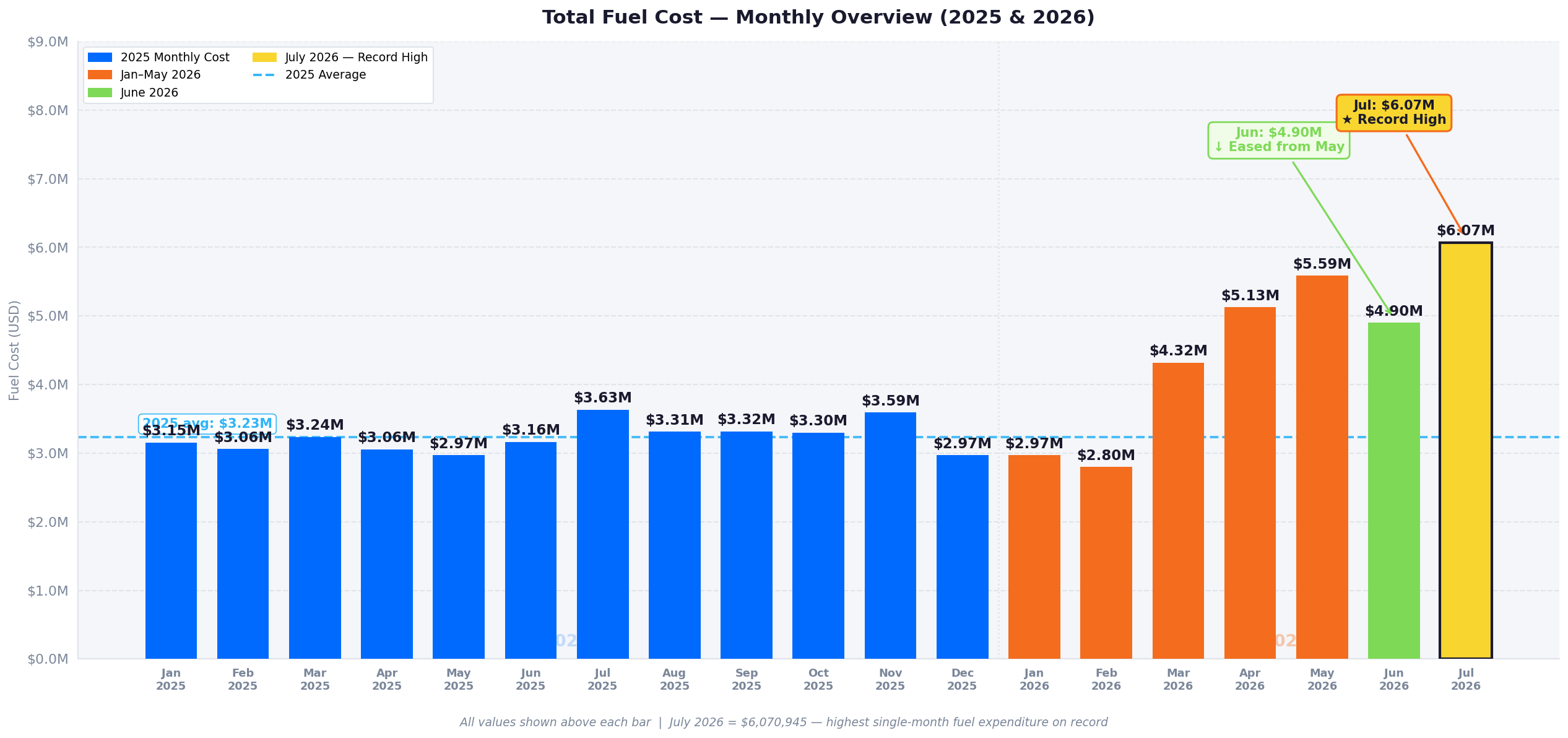
1) Total Fuel Cost Consumed: June $4,901,361 | July $6,070,945
(May: $5,586,749 | April: $5,125,133 | 2025 Peak July: $3,630,979 )
What it Means:
June offered brief relief, with fuel costs consumed falling to $4.90 million as prices eased to $3.4052 per gallon. July reversed that trend dramatically, reaching a record $6.07 million as fuel prices surged and peak summer demand drove consumption to 1.64 million gallons, the highest of 2026. By July, BVIEC’s 2026 fuel expenditure had reached $31.77 million.
Why it Matters:
The sharp reversal from June to July highlights the BVI’s vulnerability to imported fuel. In just one month, lower costs were erased as both fuel prices and consumption surged. With electricity rates unchanged since 1978, BVIEC has no automatic revenue mechanism to offset these sudden cost swings, placing increasing pressure on the Corporation’s finances.
Relatable Example:
In June, BVIEC’s daily fuel spend fell to $163,379, down from $180,218 in May. By July, it surged to a record $195,837 per day, more than $100,000 higher every day than January’s $95,825. That sharp increase illustrates the extraordinary daily financial impact of the Strait of Hormuz crisis on powering the Territory.
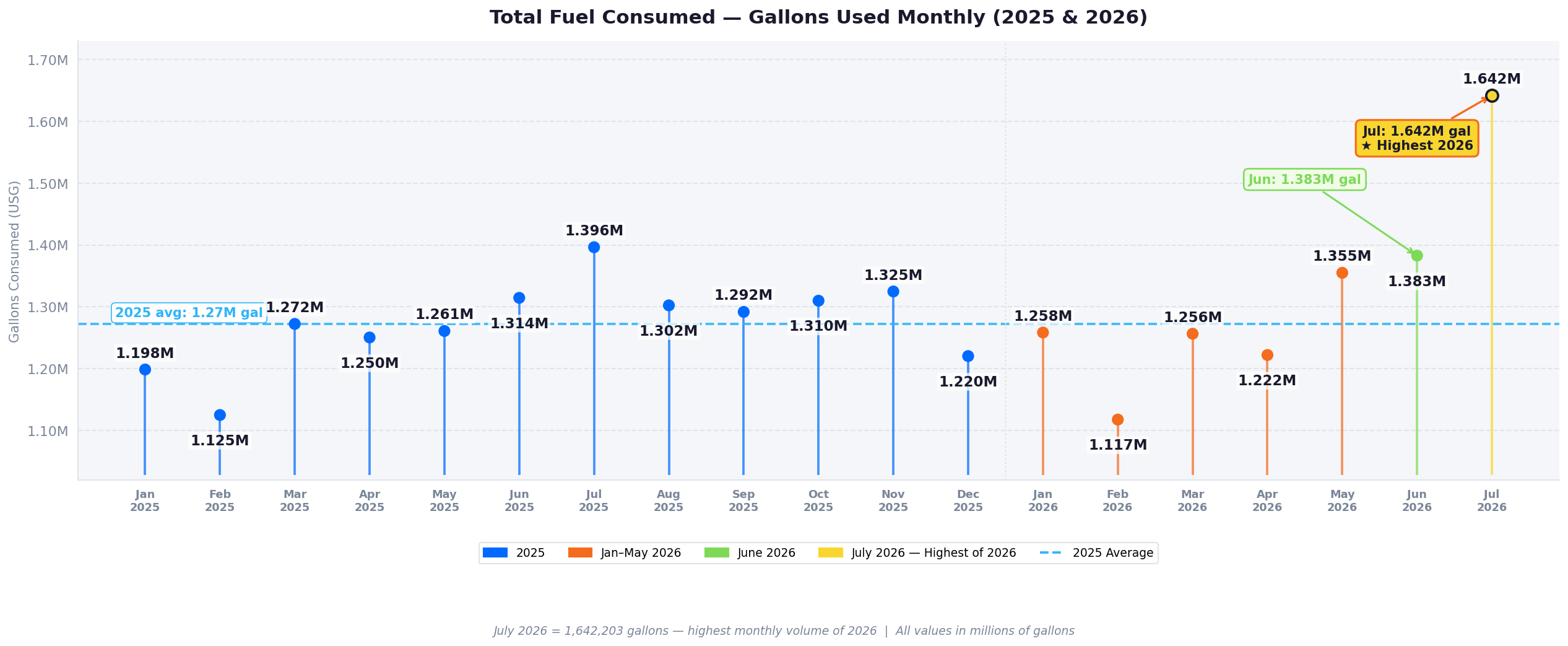
2) Total Fuel Used: June 1,382,723 gal | July 1,642,203 gal
(May: 1,354,923 gal | April: 1,221,906 gal | 2025 Peak July: 1,396,368 gal)
What it Means:
June fuel consumption rose modestly to 1.38 million gallons as summer demand began to build. By July, consumption surged to 1.64 million gallons, the highest of 2026 and well above 2025’s peak.
Why it Matters:
July demonstrates the financial impact when high electricity demand and elevated fuel prices collide. More fuel at a higher price contributed to a record fuel bill, reinforcing the BVI’s vulnerability to imported fuel and the importance of accelerating the transition to renewable energy.
Relatable Example:
July’s 2026 consumption exceeded July 2025’s peak by 245,835 gallons. At July’s $3.9609 per gallon, that additional volume alone represents approximately $974,000 in fuel costs, while fuel prices were also nearly 50% higher than a year earlier.
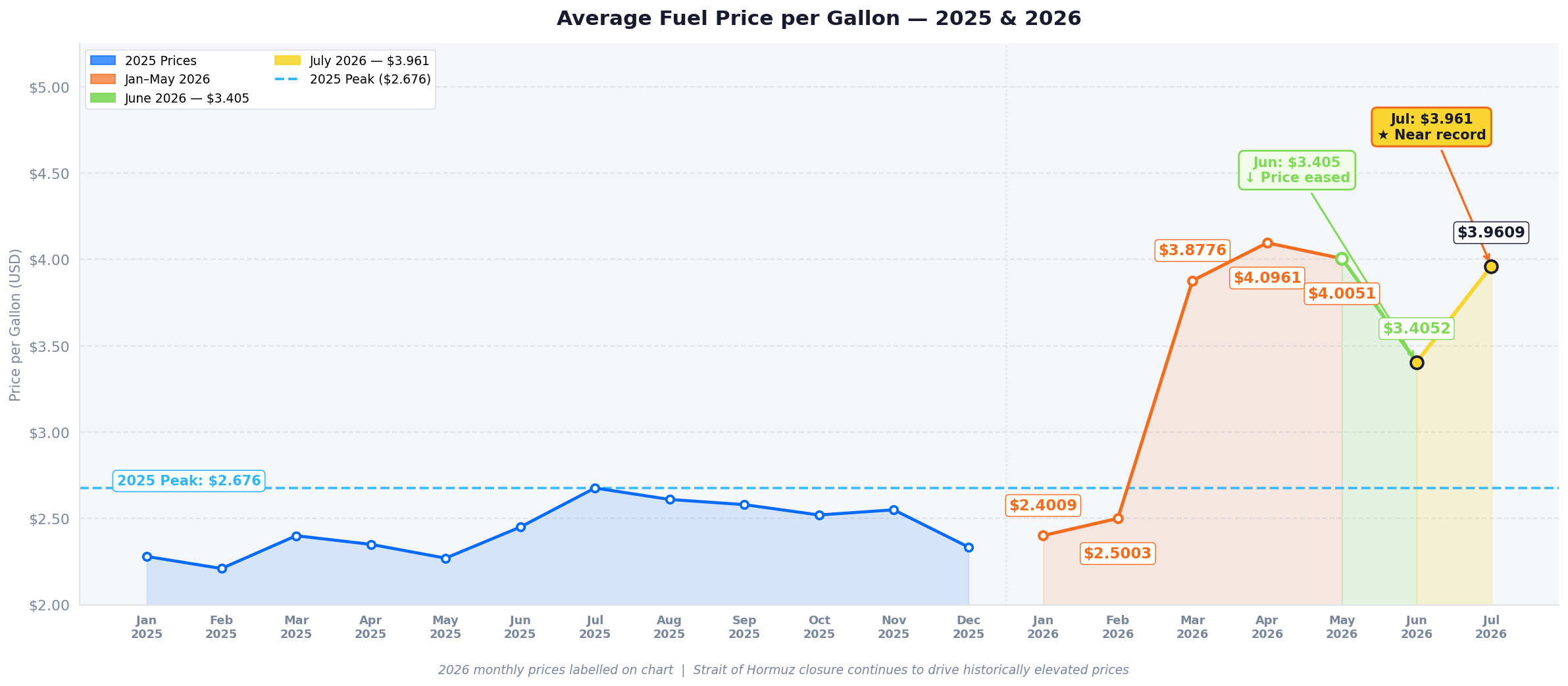
3) Average Fuel Price: June $3.4052 | July $3.9609
(May: $4.0051 | April: $4.0961 Record High | 2025 Highest: $2.6763)
What it Means:
June’s average fuel price fell to $3.4052 per gallon, the largest monthly decline of 2026, providing temporary relief. In July, that progress reversed as prices jumped to $3.9609 per gallon, returning to near-record levels and increasing pressure on fuel costs and customer surcharges.
Why it Matters:
A $0.56 per gallon increase in just one month shows how quickly global fuel markets can affect BVIEC. Applied across July’s 1.64 million gallons of consumption, that price movement represents roughly $913,000 in additional fuel value compared with June’s price.
Relatable Example:
56 cents may not sound like much until it is multiplied by over 1 million gallons of diesel oil.
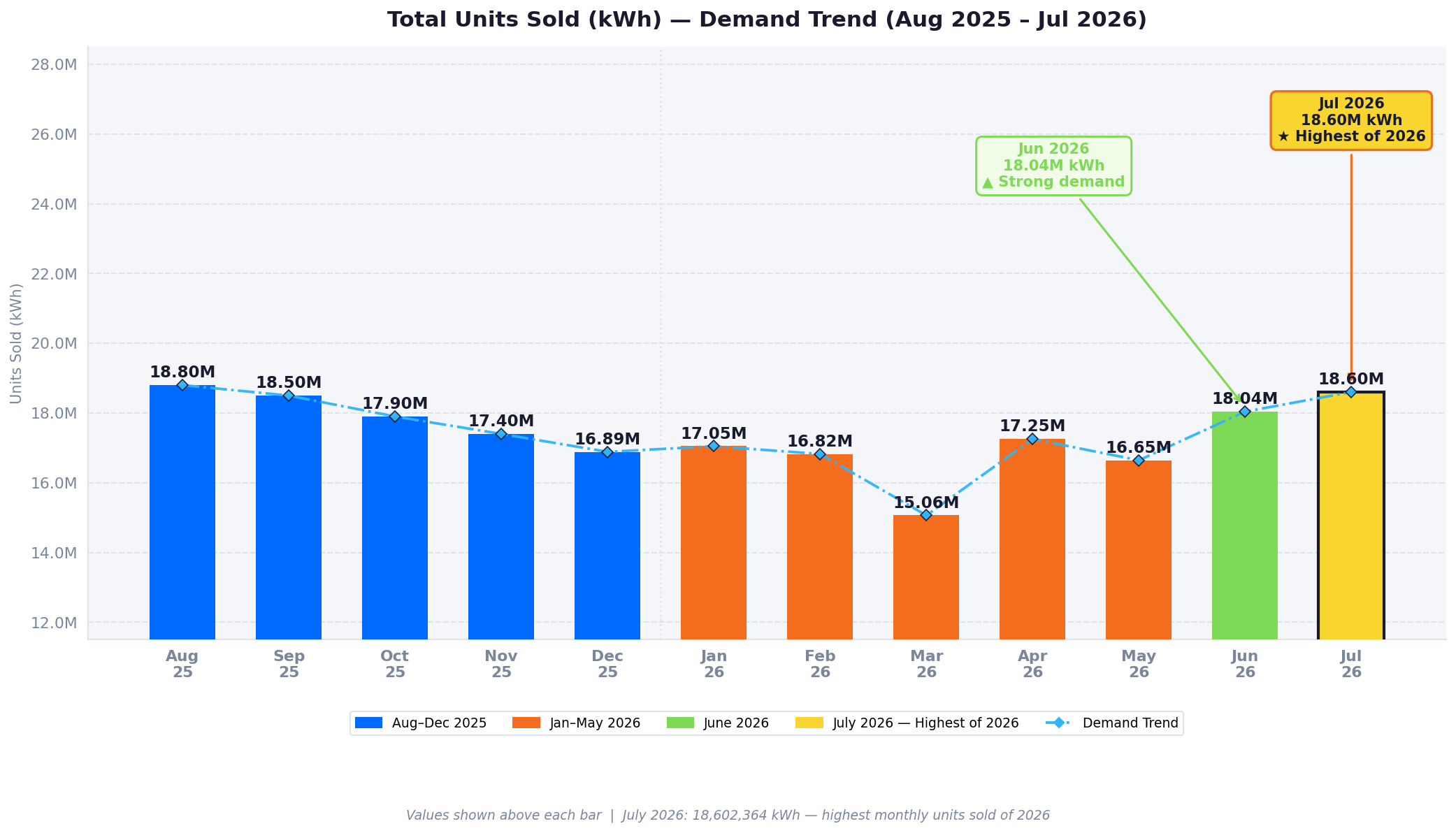
4) Total Units Sold: June 18,039,745 kWh | July 18,602,364 kWh
(May: 16,645,119 kWh | April: 17,252,929 kWh | March: 15,064,889 kWh — Lowest of 2026)
What it Means:
Summer electricity demand surged, with June reaching 18.04 million kWh before July climbed to 18.60 million kWh, the highest of 2026. Together, customers used 36.64 million kWh in just two months, highlighting the significant increase in electricity demand during the BVI’s peak summer period.
Why it Matters:
High summer demand is expected. What makes 2026 exceptional is that peak electricity consumption is coinciding with near-record fuel prices. This combination places maximum financial pressure on both BVIEC and customers, making June and July among the most costly periods for powering the Territory.
Relatable Example:
In July alone, the Territory used an average of approximately 600,000 kWh every day.
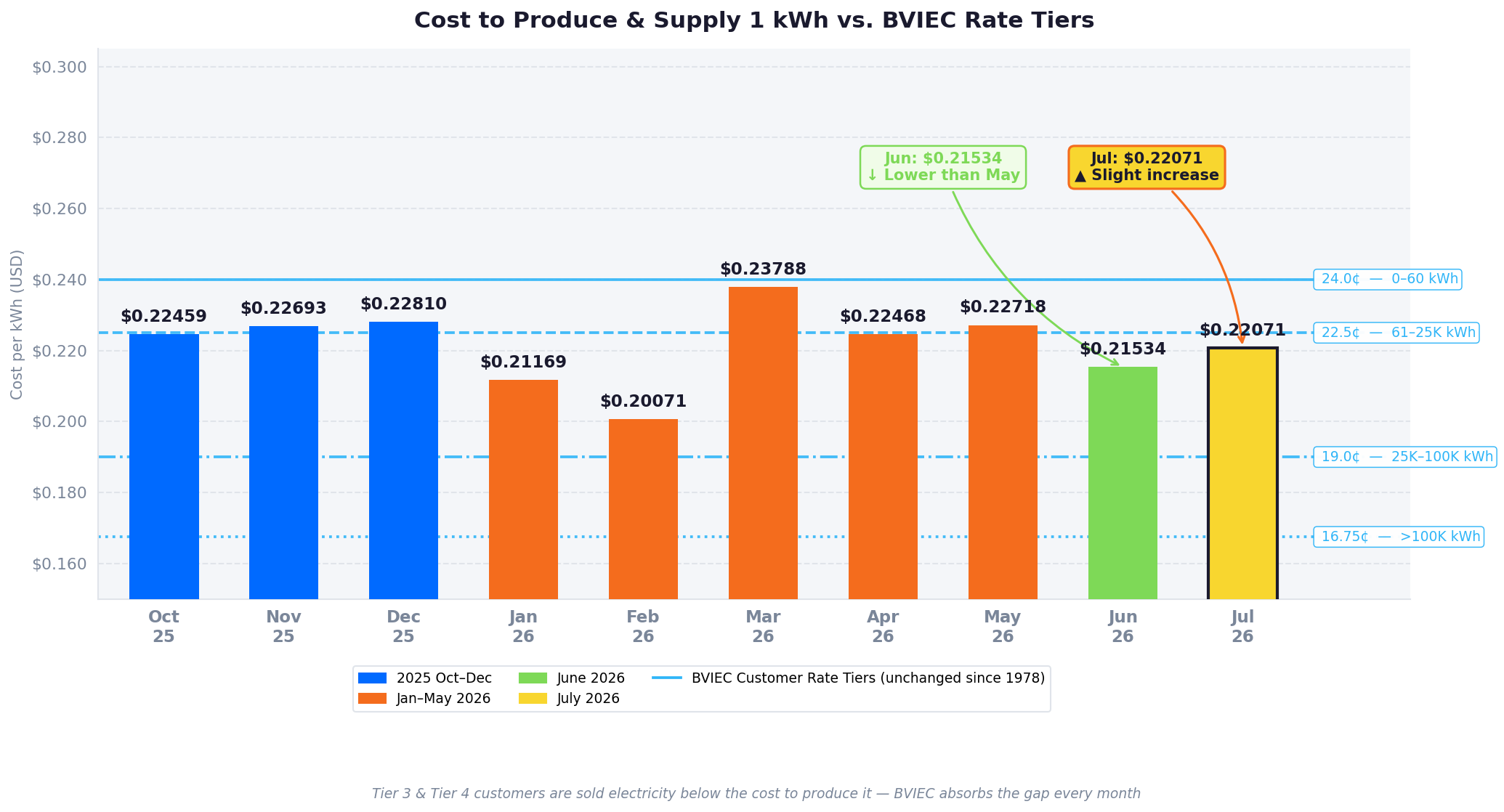
5) Cost to Produce & Supply 1 kWh: June $0.21534 | July $0.22071
(May: $0.22718 | April: $0.22468)
What it Means:
June’s cost to produce and supply electricity fell to 21.53¢ per kWh, the lowest of 2026, before rising slightly to 22.07¢ in July as fuel prices increased. At these levels, Tier 3 and Tier 4 base rates remain below BVIEC’s actual production and delivery cost.
Why it Matters:
The cost to produce each kilowatt-hour drives the fuel surcharge. In May, BVIEC spent 22.7 cents per kWh, while some customers paid just 16.75 cents under rates unchanged since 1978, continuing the gap between production costs and revenue.
Relatable Example:
For every 1,000 kWh generated in May, it cost BVIEC $227.18. A large-volume customer on the lowest rate tier contributed just $167.50 toward that total, leaving BVIEC absorbing $59.68 per 1,000 kWh, before subsidies are even considered.
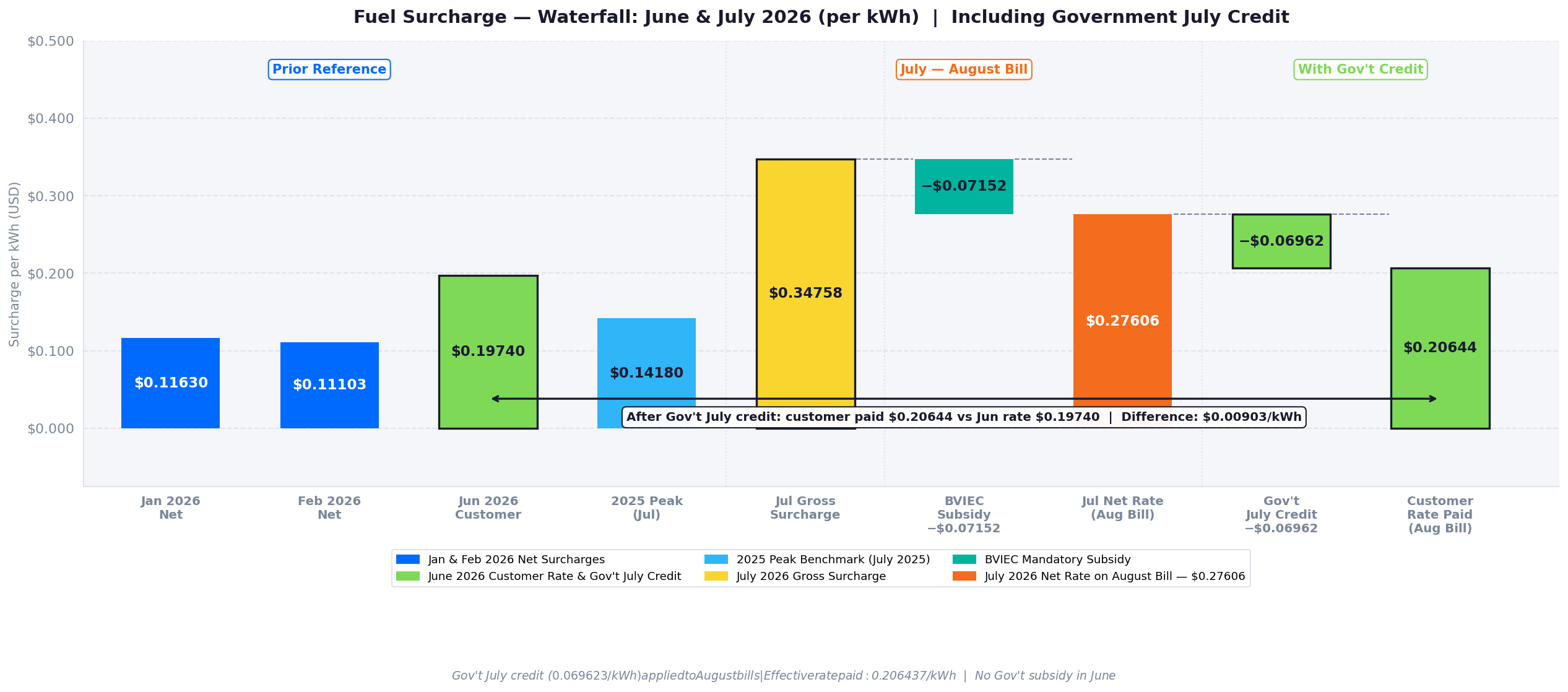
6) Fuel Surcharge: June $0.19740 | July $0.27606 (Net) → $0.206437 (After Gov’t Credit)
(May: $0.25804 | Jun Gross: $0.25951 | Jul Gross: $0.34758 | Previous record: $0.24911 — Russia-Ukraine War Jun 2022)
What it Means:
June’s gross fuel surcharge of $0.25951/kWh was reduced by BVIEC’s mandatory subsidy to $0.19740/kWh for customers. In July, record fuel costs pushed the gross surcharge to an unprecedented $0.34758/kWh. BVIEC absorbed a portion of that, reducing the customer surcharge to $0.27606/kWh, the highest net surcharge in BVIEC’s available records.
Following discussions between BVIEC and the central Government, a Government credit was announced to help offset the impact of the July fuel costs reflected in customers’ August bills.
Why it Matters:
July demonstrates the direct connection between global fuel prices and customers’ electricity bills, but also the impact of coordinated relief.
Relatable Example:
For a customer using 415 kWh, July’s gross fuel surcharge would have been approximately $144.25.
BVIEC’s $0.07152/kWh fuel subsidy absorbed about $29.68, reducing the customer’s fuel surcharge to approximately $114.57.
The Government’s subsequent credit provides a further $28.89 in relief, bringing the effective fuel-cost impact to approximately $85.68.
7) Fuel Surcharge Subsidy: June & July total = $2,645,354.18
(May: $1,745,736.02 | April: $746,231.13)
What it Means:
BVIEC absorbed $2.65 million in fuel subsidy across June and July as global fuel prices surged. This brings BVIEC’s total fuel subsidy for January–July 2026 to $9.73 million.
Why it Matters:
BVIEC’s fuel subsidy operates every month, whether global fuel prices rise or fall. When prices ease, the amount absorbed decreases; when they surge, as in July, BVIEC’s financial obligation increases significantly.
Relatable Example:
For the combined June and July period, every electricity customer in the Territory received the equivalent of just over $202 in fuel cost protection before their bill was ever printed.